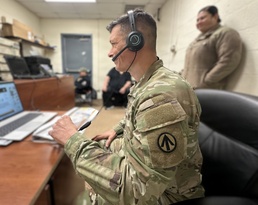
FORT EUSTIS, Va.– Soldiers from the 597th Transportation Brigade, U.S. Army Transportation Command (ARTRANS), Operations team (S3), joined the Rapid Support Signal Team staff for a brigade-wide test of the communications plan at an undisclosed location at Fort Eustis, Virginia, on Feb. 27, 2026.
The Communications Exercise (COMMEX) was a critical test of the brigade’s “PACE” plan, which provides primary, alternate, contingency, and emergency backup resources to ensure the network remains ready and effective at any contested or congested port. The exercise supports the Army’s mission to project the force in support of warfighters at home and abroad.
COMMEX and robust communication systems are foundational to unified command, enabling multi-agency, integrated, secure, and interoperable real-time data sharing. These systems ensure a common operating picture, synchronize network systems, and validate joint procedures before real-world events.
The February COMMEX demonstrated the brigade’s ability to respond to system outages and provide critical network access to the team. It also reinforced the plan to integrate with the Joint Force, civilian partners, and port authorities on the ground—known as the “fourth component”—to support large-scale combat operations.
Army veteran and Department of the Army (DA) civilian Chris Peters, information technology (IT) team lead and deployable communications specialist for the 597th, provides valuable hands-on expertise to the Rapid Support Signal Team. Peters brings 24 years of prior service experience and multiple deployments, first as a communications specialist for the light infantry and later as a deployable communications capital networks specialist in a signal battalion.
Peters oversaw the exercise and emphasized the importance of maintaining communications access.
“In the event that our primary and alternate systems don’t work, we would move our communications over to a contingency medium to conduct full-scale operations as part of our PACE plan,” Peters said. “We are operational 24 hours a day, seven days a week, 365 days a year. We establish secure data and voice systems and check our network viability regularly to ensure we can support the command independent of local system availability and in austere conditions, whenever and wherever needed as part of regular port operations across the globe.”
“I love taking people from the unknown to the known,” Peters added, explaining the importance of PACE plans in providing structure and continuity for Soldiers and leaders. “There is no guesswork. We can make sure the plan is enacted seamlessly.”
Peters praised his team’s cohesion and highlighted the contributions of Ronald Taylor, a 597th IT specialist who helped plan and provide support for the event.
Taylor, who has 20 years of prior service as an Army communications specialist—most of it at Fort Eustis—and 13 years as a DA civilian under the ARTRANS banner, echoed Peters’ sentiments.
“Our team works extremely well together,” Taylor said. “We have worked together so long, we all know each other’s strengths and how to communicate with each other to get the job done efficiently.”
Taylor explained that COMMEX fortifies network plans, ensuring there is no break in communication between commanders and troops, regardless of the situation on the ground.
The 597th regularly strengthens the resilience of its communications systems against threats—whether cyber, electromagnetic, natural disasters, or digital—to safeguard its ability to conduct surface transportation missions at scope, scale, and need.