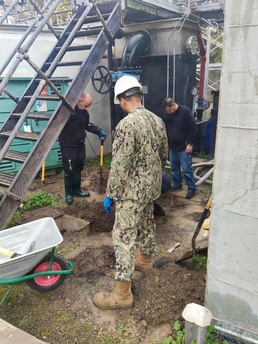
NAVAL AIR STATION SIGONELLA, Italy — As severe weather swept across Sicily on Jan. 20-21, a unified team from Commander, Naval Installations Command (CNIC) and Naval Facilities Engineering Systems Command (NAVFAC) Europe Africa Central protected critical infrastructure at Naval Air Station Sigonella, ensuring the mission never stopped despite significant threats from widespread flooding that placed its infrastructure, personnel and mission at considerable risk.
The response was managed by the installation’s Public Works Department (PWD) Sigonella, which integrates NAVFAC’s engineering and acquisition expertise with the operational requirements of the CNIC-led installation.
“This achievement rests squarely on the shoulders of our integrated Public Works Department,” said Capt. Daniel Martins, commanding officer, NAS Sigonella. “Their quick action in making critical repairs and keeping essential services like power and water online at our NAS 1 and NAS 2 installations was a textbook example of a unified team in action. The combined efforts of our Seabees and experienced Italian civilian personnel were key to our successful response.”
Teams of PWD Seabees and civilian personnel spread across the installation’s two main sites, NAS 1 and NAS 2. At the installations wastewater treatment plant on NAS 2, NAVFAC-managed Italian national operators Antonio Roberto Gelardi and Salvatore Laudani led the emergency flooding response, promptly reactivating plant systems.
Simultaneously, at NAS 1, operators Giuseppe Annino, Antonino Nipitella, and Gianfranco Scandurra repaired a critical leak on the main air supply line of the sludge treatment plant, restoring the plant to full operational status in less than 24 hours.
“In a crisis there is no substitution for experience and training. Our Italian experts, who are part of the NAVFAC team, have decades of knowledge on these specific systems and we’re incredibly fortunate to have them said Cmdr. Seth Cochran, NAS Sigonella public works officer and NAVFAC’s on-site representative. “Coupled with standard operating procedures, the team’s skill and experience allowed for rapid, precise repairs critical to a quick recovery. Their professionalism is the bedrock of our public works team.”
The pipeline repairs also depended on a major excavation by Navy Seabees and civilian colleagues from PWD. The team removed about 11,000 pounds of soil along a 56-foot trench to access the damaged line. In other areas, Seabees pumped about 158,000 gallons of liquids from flooded fuel tank basins and an additional 2,600 gallons of water from the base galley area.
“The Seabees showcased their ‘Can Do’ spirit. Their rapid response in flood control and excavation neutralized the threat in record time,” said Cochran. “They brought expeditionary readiness and technical skill to bear during the excavation and flood control efforts. They are a testament to what a well-trained and motivated force can accomplish.”
Cochran concluded that the seamless integration between CNIC’s operational needs and NAVFAC’s technical execution was the key to ensuring the mission never faltered.
He said, “What we witnessed was a textbook display of skill, training, and professionalism under pressure.”
About Naval Facilities Engineering Systems Command Europe, Africa, Central Naval Facilities Engineering Systems Command is the naval shore facilities, base operating support, and expeditionary engineering systems command delivering life-cycle technical and acquisition solutions aligned to fleet and Marine Corps priorities. NAVFAC EURAFCENT delivers construction, engineering, and contracting as a critical component of the Navy Shore Enterprise across Europe, Africa, and Central commands to enable Fleet and joint force lethality and power projection across the competition continuum.
Media Inquiries: NAVFAC EURAFCENT Public Affairs mailto:NAVFAC-EAC-PAO@us.navy.mil