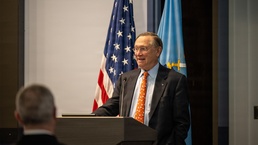
FORT BELVOIR, Va. — In a decisive move to bolster national security, the Honorable Dr. Robert Kadlec, Assistant Secretary of War for Nuclear Deterrence, Chemical, and Biological Defense Policy and Programs, delivered a powerful keynote address on March 12 at the "Framework for Biological Weapons Deterrence: Report Rollout." Co-hosted by the Defense Threat Reduction Agency (DTRA) and the National Defense University (NDU), the event united over 100 senior leaders to establish a strategic front against the rapidly evolving threat of biological warfare.
Dr. Kadlec leads the initiative aimed at collapsing traditional timelines to ensure no adversary benefits from the use of biological agents. Dr. Kadlec warned that the U.S. maintains a wide range of response options, stating, "It is an international imperative to make clear that those who employ biological weapons will regret their choice."
The campaign translates these strategic concepts into action through three functional pillars:
The rollout featured a high-level panel with representatives from the Department of War, the Joint Staff, and the State Department. This group explored how to synchronize current initiatives to create a "denial defense." By integrating the ingenuity of the private sector with government authority, the Department seeks to foster a global norm where the weaponization of biology is viewed as strategically futile.
The dialogue underscored that biological deterrence is no longer a theoretical exercise but a high-stakes operational necessity. Dr. Kadlec emphasized that while the U.S. remains in full compliance with treaty obligations, the lack of good faith from adversaries requires an urgent, unified response. This event laid the groundwork for the upcoming update to the Biodefense Posture Review.
The DTRA-NDU partnership has successfully moved the needle toward a holistic strategy. By combining robust technical capabilities with the clear-eyed resolve of the Four "C"s, the United States is positioning itself to manage escalation and preserve regional stability. As Dr. Kadlec concluded, the goal is simple: ensuring the U.S. is never left vulnerable to biological blackmail.
This successful event demonstrated a strong collaborative commitment and served as an important platform for strategic messaging. National Defense University has officially released the full findings and recommendations to guide future interagency and allied support. The complete "Framework for Biological Weapons Deterrence" report is available for review on the NDU website at: https://inss.ndu.edu/Media/News/Article/4435123/a-framework-for-biological-weapons-deterrence/