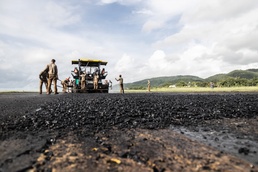
When a long-dormant airfield in Puerto Rico needed to be brought back to life, the call went to the legendary 823d Rapid Engineer Deployable Heavy Operational Repair Squadron Engineer (RED HORSE) Squadron at Hurlburt Field in Florida.
Within days, a 21-Airman team led by Master Sgt. Dylan Ashley was on the ground at the former Naval airfield in Ceiba, now known as José Aponte de la Torre Airport. The mission was to repair and restore critical taxiways that had not supported Department of War aircraft operations since 2004.
"The timeline was accelerated, and the project followed suit. Rumors surfaced Sunday, orders came Wednesday, and by Saturday the team was airborne. Within 48 hours of arrival, milling operations were underway."
“If I could use one word to sum it [the mission] up, it would be fast,” Ashley said.
For Tech. Sgt. Derek Purdin, the craft lead on the mission, the pace defined the deployment.
“The deployment to Puerto Rico was a standout and unique experience in my Air Force career,” Purdin said. “The mission was fast paced, with rapid tasking: from notification to on-the-ground execution in under a week. Everything brought a high level of intensity and excitement with it.”
He added that leadership’s focus was clear from the start. “What stood out most was the clear prioritization of mission success and efficiency. Leadership emphasized, ‘What do you need to complete this as quickly and effectively as possible?’”
The objective was clear: eliminate foreign object debris risks, repair failing asphalt overlay, and return the airfield to fully mission-capable status to support Marine and Air Force aircraft operations under U.S. Southern Command.
Years of deterioration had left portions of the airfield in poor condition. Asphalt laid over original concrete had degraded significantly, creating FOD hazards that made aircraft operations unsafe.
RED HORSE engineers moved quickly. In just two weeks, both taxiways were restored, allowing military aircraft to land and launch without concern.
The team laid 800 tons of asphalt on their first paving day, 900 tons on the second, and then consistently achieved 1,000 tons per day – despite using rented equipment they had never operated before.
Because of the rapid deployment timeline, the squadron could not transport its organic heavy equipment. Instead, Airmen operated locally sourced milling machines and pavers with unknown maintenance histories. While equipment malfunctions, language barriers with contractors, and unpredictable Caribbean weather added complexity to the mission, nothing was going to get in its way.
Nine of the 21 Airmen had never performed a mill-and-overlay project before. Many were fresh from technical training.
“My biggest takeaway was witnessing how capable Airmen become when they are entrusted, challenged, and united behind a purpose bigger than themselves,” said Staff Sgt. Ryan Guevara Seamster, NCO who was responsible for operating the asphalt paver. “It also showed me how quickly new RED HORSE members can adapt and rise to the occasion.”
Under pressure and on an accelerated schedule, like true civil engineers, they adapted and delivered.
For Capt. George Horiates, an Army exchange officer who served as officer in charge for the detachment, Puerto Rico marked his first operation under CED orders.
“I saw firsthand the importance of being forthcoming about your unit’s assets and capabilities when integrating with a new organization,” he said. “Command teams outside the Engineer Regiment may not accurately understand your unit’s full potential, leading to ineffective utilization.”
To ensure proper employment, Horiates, Ashley, and Senior Enlisted Leader Master Sgt. Martinez, who played an instrumental role in conducting site assessments for other potential horizontal construction projects on the island, delivered a formal Assets and Capabilities brief to the Air Expeditionary Wing command team. The presentation detailed equipment, personnel, and specialized training. It explained how those capabilities could shape the operational environment.
In addition, the team established a battle rhythm of weekly situation reports to the AEW command team and higher headquarters.
“As a former Army Brigade staff officer, I knew that regular situation reports would minimize confusion, keep the staff informed, and ensure our detachment was being gainfully employed,” Horiates said.
That deliberate communication ensured the runway repair mission was fully synchronized with broader operational objectives in the region.
The impact of the Puerto Rico runway restoration extended well beyond the team and island.
During his keynote address at the Feb. 23 Air and Space Forces Association’s 2026 Warfare Symposium, Gen. Ken Wilsbach highlighted the critical role civil engineers play in generating airpower. He specifically referenced Ashley and his team, underscoring how airfield repair and maintenance directly enable the joint force to operate. By spotlighting the mission, the Chief reinforced a simple but strategic reality: without safe, serviceable runways and taxiways, there is no airpower.
“Having this mission and our work recognized by Air Force leadership and the CSAF means more to me than words can describe,” reflected Airman Kyle Nixon, a Pavements and Construction Equipment Apprentice that took part in the mission. “Knowing what my team and I accomplished in such a short amount of time and how well we executed it makes me feel proud of the contribution we made to something so important.”
While the Puerto Rico mission showcased the capability of RED HORSE engineers, Ashley’s leadership was shaped long before this deployment.
For Ashley, leading under pressure was not a skill developed overnight. As a college student, he lost his father – a retired Army veteran – to a sudden heart attack.
“I went from a young adult at 19, who thought he was grown, to having to take care of myself completely overnight,” Ashley said. “It changed my whole perspective on life. I had to grow up faster than most people have to.”
Balancing work and school while reassessing his future, Ashley eventually joined the Air Force, drawn to hands-on work that allowed him to build and fix tangible infrastructure.
“I found out that I like building things and having a tangible thing that I can touch and see that I've left my mark on,” Ashley said.
Later, as a military training instructor at Joint Base San Antonio-Lackland, he learned that effective leadership requires more than intensity. It demands patience, empathy and the ability to reach people differently. Those lessons carried forward into Puerto Rico, where nearly half his team had never executed a full mill-and-overlay operation.
For Ashley, recognition is secondary to impact. As the current Superintendent of Special Capabilities in charge of 40 engineers, he reminds his Airmen that civil engineering is often a thankless job and rarely draws public attention. However, it is a job that is essential every time an aircraft takes off.
“I don't care if you have the best pilots, maintainers, or security in the world,” Ashley said. “Whatever it is, you cannot generate air power without runways, taxiways, and aprons.”
The restored airfield immediately supported joint operations, including Marine aviation units operating from the island. The mission aligned directly with the Air Force’s “Fly, Fix, Fight” directive, ensuring aircraft could generate airpower in support of regional security objectives.
While the airfield had not hosted Department of War aircraft in nearly two decades, after RED HORSE completed its work, it could once again serve as a platform for joint force operations.
Three taxiways. Six weeks. Zero room for failure. Because when the nation calls, airpower must answer, and airpower starts with a runway.