The Washington Army National Guard is undergoing a sweeping transformation that will reorganize units, relocate formations across the state, introduce new technology-driven missions and modernize key career fields.
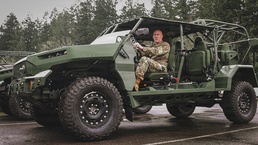
Already underway is the transformation of the 81st Stryker Brigade Combat Team, which is replacing its Strykers with lighter, faster vehicles and implementing a dramatically different force structure as the brigade transforms to a mobile brigade under the Army’s ongoing transformation initiative.
"Change isn’t always easy, but this is a big win for us,” said Brig. Gen. Paul Sellars, commanding general of the Washington Army National Guard when the change was announced in September 2025. “Being chosen to make the shift to a mobile brigade is a testament to our organization and shows just how strong and capable our team is.” Equipment changes are already underway. The 81st began turning in Stryker vehicles in late 2025, and the brigade’s first Infantry Squad Vehicles are expected to arrive in Spring 2026. The full fleet should be delivered by early 2027 in time to support a rotation at the National Training Center.
Meanwhile, communication efforts have begun to help soldiers being affected by the transformation find new units to continue their service. Along with new equipment, the brigade is implementing a new Modified Table of Organization and Equipment (MTOE), which will take effect by the end of March. The change will reorganize several units across the formation and lead to the deactivation of the 898th Brigade Engineer Battalion.
“We knew this was going to be a significant change for the force structure, but we did the best we could to return units back their historic lineage,” said Sellars.
The battalion, which includes combat engineer, signal, military intelligence and headquarters companies, will case its colors as part of the restructuring, though several subordinate elements will continue under their historic lineages elsewhere in the state.
This will mark the second time in the past two decades that the 898th Battalion’s colors have been cased. The unit previously deactivated in 2005 after returning home from Iraq. While the battalion headquarters will inactivate again, elements of the unit will continue under different designations. A Combat Engineer Company – Infantry will remain in Vancouver and carry on the 898 lineage, while the battalion’s Military Intelligence and Signal companies will revert to their historic designations as the 281st Military Intelligence Company and the 241st Signal Company, remaining at Camp Murray and Marysville, respectively.
By the summer of 2026, both the 1st and 3rd Battalion, 161st Infantry Regiment will add a new Multi-Purpose Company (MPC), a newly developed, experimental, high-tech reconnaissance and strike unit, to their MTOE. These units will be stationed at Geiger Field in Spokane and Marysville, respectively.
The 161st will also stand up a new Multi-Functional Reconnaissance Company that will report directly to the 81st Brigade command and be located on Camp Murray. This experimental unit is designed to provide brigade commanders with advanced, integrated reconnaissance, surveillance, and electronic warfare capabilities, using drones, robotics, and traditional infantry scouts to find, fix, and potentially destroy enemy targets with cutting-edge tech for Multi-Domain Operations.
“This is an exciting time to be in the 81st Brigade, with the new force structure, new vehicles and emerging missions,” said Sellars.
Several units will also relocate as part of the transformation:
Detachment 1, Bravo Company, 1st Battalion, 161st Infantry Regiment will move from Walla Walla to join the rest of the unit at the new Richland Readiness Center.
Detachment 1, Alpha Company, 3rd Battalion, 161st Infantry Regiment will move from the Redmond Armory to join the rest of the unit at the newly renovated Anacortes Readiness Center.
Detachment 1, Headquarters and Alpha Batteries, 2nd Battalion, 146th Field Artillery Regiment will relocate to the Thurston Country Readiness Center.
The 181st Brigade Support Battalion will also undergo changes as its companies reflag under new designations. Golf Company 181st Brigade Support Battalion will move from Ephrata to the Yakima Training Center Armed Forces Readiness Center and become Charlie Company.
Significant changes are also planned for the Information Operations and Public Affairs career fields within the 56th Theater Information Operations Group.
In 2025, the Army ordered the implementation of a new Information Warfare (IWar) branch to consolidate, streamline, and modernize capabilities for competition, crisis, and conflict. Information Warfare is a key part of the Army’s continuous transformation across the components. Led by the Special Operations Center of Excellence (SOCoE), this branch merges Information Operations (FA 30) and Psychological Operations (PSYOP) personnel to create a unified, specialized force that operates across information, human, and physical dimensions of the operational environment to deceive, disrupt, degrade or destroy enemy troops, systems, and decision makers.
“The IWAR Branch will consolidate, focus, and bring unity of effort to develop, integrate, and affect an adversary’s Command and Control, while protecting our own,” said Col. Casey De Groof, commander of the 56th Theater Information Operations Group. “The skill sets within the 56th to provide strategic intel, inform, influence, and operationalized protection not only align, but will grow with this initiative.”
Another major change announced in January 2026 was the Army’s decision to make Public Affairs an official basic branch.
“The Inform function is a critical part of gaining information advantage, and our 122nd Public Affairs team is uniquely practiced and situated to contribute to the Army’s transformation of operations in the information environment. These branch changes showcase the importance of professionalizing information for the future fight,” De Groof added.
Public Affairs personnel, including officers (46A) and specialists (46S), act as media liaisons, create content, and advise commanders. They tell the Army's story through news, social media, and community engagement to support recruitment and operations.
Currently officers transition into the Public Affairs career field after spending time in their basic branch. This change will help with developing new officers and expand career opportunities for enlisted soldiers and will be fully operating as a branch by the end of 2026.
The 341st Military Intelligence Battalion will see one unit move during the transformation, as Alpha Company, 341st Military Intelligence Battalion leaves Fairchild Air Force Base in early fiscal year 2027 and joins the rest of the battalion at the Information Operations Readiness Center on Joint Base Lewis-McChord, Wash.
“The units of the 56th all have an important role in transformation and in strengthening our Guard partnerships throughout the Indo-Pacific,” said De Groof. “The consolidation of the 341st allows our teams to streamline activities and take advantage of the training and relationships we have across units on JBLM.”
The 96th Troop Command will also experience significant movement in late fiscal year 2026 and early 2027.
The 506th Military Police Detachment will move from the Information Operations Readiness Center to the Redmond Armory, which gives it their first stand-alone unit since leaving the Centralia Armory in 2019.
Meanwhile, the 286th Engineers Fire Fighting Team, a specialized unit that handles military-grade fires, will move from Pangborn Memorial Airport to Yakima Training Center.
The 144th Digital Liaison Detachment will move before the end of the year from Geiger Field to the Aviation Readiness Center on Joint Base Lewis-McChord. The 144th DLD provides liaison capability between Army forces and multinational headquarters to ensure communication, mutual understanding, and unity of purpose and action.
“The DLD works a lot with I Corp and our active duty counterparts on overseas deployment training, so this move makes sense for them,” said Sellars.
One of the most significant moves will happen in early 2027 as 96th Troop Command’s Headquarters and the Headquarters for the Washington National Guard’s Homeland Response Force (HRF) moves from Joint Base Lewis-McChord to the Armed Forces Reserve Center on Fairchild Air Force Base. The move puts all command and control and units that are part of Washington’s HRF in eastern Washington.
“This is a legacy move that has been discussed for some time,” said Sellars. “By moving the 96th headquarters to Fairchild, the Homeland Response Force can come together quickly in the event of a large scale disaster, like a Cascadia Subduction Zone earthquake in western Washington. It also moves a major subordinate command to the Spokane area and provides growth opportunities in eastern Washington.”
Despite the changes, leaders say the transformation will create new opportunities for soldiers across the formation.
“Our troops are going to be able to look across the new formation and find opportunities,” said Sellars. “It’s going to give opportunities for everyone we have to serve. They might be in different places or different jobs or locations, but still here serving at home in Washington.”