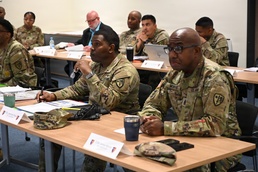
SEMBACH, Germany-- For a command whose members are spread across 24 countries, the opportunity to come together is invaluable. U.S. Army NATO leadership convened here for their Quarterly Touch Point February 24-25, uniting command teams from the brigade, its two battalions, and nine companies to sharpen their collective focus.
The event, QTP 26-1, was designed to build a shared understanding of readiness across NATO, identify best practices, and develop confident leaders. The U.S. Army provides Soldiers to NATO at every level, and the U.S. Army NATO Brigade ensures these personnel and their families have the logistical and human resources support they need to remain resilient and ready to support the multinational partnership.
The two-day event was packed with semi-annual training briefs, battalion break-out sessions, morale-building physical fitness, and professional development, all designed to reinforce the unit's core mission.
Col. Jeremiah D. Pope, commander of the U.S. Army NATO Brigade, kicked off the training by setting a clear objective. He framed the event not as a new beginning, but as a crucial check-in on continuing progress.
"This event is just a continuation of the last time we met,” Pope stated. “I want to see what progress we've made since then, focusing in on what training you have conducted to get after the goal of readiness, specifically for your tier-one organizations."
His subordinate commanders were ready to demonstrate their progress. Lt. Col. Natalie Meng, who commands the Allied Forces South Battalion from Naples, Italy, saw it as a key moment to align with the brigade's goals. "This is a great opportunity to show you what we've been working on in this last quarter," she explained, "and how we're going to move forward in the next quarter.”
For company-level leaders, the QTP provided a vital link to the higher echelons of command. Capt. Jennifer Zimmerman, of Company B, Allied Forces South Battalion, highlighted the practical benefits of the sessions.
"It gives us, as a company command team, the opportunity to go over the plans and operations that we would like to have," she said. The direct feedback from senior leaders is critical, as "it gives them the opportunity to either provide insight or guidance and support as needed from the elements that we may not have readily available to us."
Beyond the strategic planning, the human element of the gathering proved to be one of its most valuable aspects. For leaders operating in different countries, the simple act of being in the same room was a powerful tool for building cohesion.
Capt. Zimmerman emphasized this, noting that the personal interaction was what she looked forward to the most. "I am just very excited to be essentially reunited with my fellow commanders because we don't get that time together outside of meetings,” she shared. “So getting to actually meet teammates who are in this command struggle... for me has been my favorite part."
Capt. Mark Howard, from Company A, Allied Forces North Battalion in Brunssum, Netherlands, echoed that sentiment, stressing the irreplaceable value of face-to-face communication. "There's something to be said about actually being in front of a person that you can ask the questions and immediately respond to facial cues and body language," he remarked. "There's way more to communication than just hearing words."
Howard explained that this personal connection is the foundation of their unique, geographically dispersed mission. "This is a great event because we are so geographically dispersed and this is one of our few opportunities during the year to all get together," he said. "QTP 26 allows us an opportunity to really foster an environment of teamwork which helps us with our end goal: taking care of Soldiers and their families and ensuring that our mission is accomplished.”
By the end of the training, the leaders reaffirmed their collective strength. As Pope concluded, the event confirmed that “U.S. Army NATO is trained, capable, and ready to provide Title 10 support and administrative agent execution to enable NATO formations in the implementation of the SACEUR’s (Supreme Allied Commander Europe) guidance for collective deterrence and defense of the alliance.”
U.S. Army NATO supports approximately 800 U.S. Soldiers, with about 725 assigned to NATO billets across 23 European countries and in Norfolk, Virginia. An additional 75 Soldiers are assigned to Military Personnel Exchange Programs and foreign schools.
These 800 Soldiers are supported by a dedicated national support element of some 275 personnel who conduct mission essential training to achieve and maintain rapid deployment readiness, improve interoperability with allies and partners and protect U.S. personnel and interests.