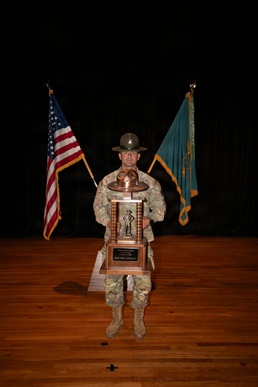
FORT BENNING, Ga. — Drill sergeants traded in their campaign hats for patrol caps as they took aim in the 2026 U.S. Army Small Arms Championships at the Maneuver Center of Excellence March 8–14.
The U.S. Army Marksmanship Unit hosts the annual championships — widely known as All-Army — because they are open to Soldiers from all Army components: active duty, Reserve, National Guard and Reserve Officers’ Training Corps cadets. The weeklong live-fire training event tests competitors on both their primary and secondary weapons, with the goal of raising marksmanship standards and increasing lethality across the force.
For drill sergeants — the first leaders new recruits encounter — the championships offer a rare opportunity to step out of the instructor role and test their own proficiency alongside Soldiers from a wide range of military occupational specialties.
The fact that drill sergeants set the standard for every Soldier entering the force is why there is a drill sergeant award category in the championships, said Michael Buss, operations director for the U.S. Army Marksmanship Unit. “When they compete here, they’re not only validating their own skills but bringing back new knowledge that elevates the training environment,” he said.
When drill sergeants compete and win at All-Army, we ensure they are masters of their craft and teaching the most effective techniques from day one, explained Command Sgt. Maj. Michael Ramon M. Dang, command sergeant major for the U.S. Army Marksmanship Unit. “Think about the impact when a private sees their drill sergeant not just talking the talk, but being one of the Army’s best marksmen,” Dang said. “It inspires excellence and makes the training more impactful. It instills within our newest Soldiers the critical importance of mastering their weapons.”
Among this year’s returning drill sergeant competitors is Sgt. 1st Class Matthew Leib of Alpha Company, 1st Battalion, 50th Infantry Regiment, 198th Infantry Brigade. Leib, who earned the High Drill Sergeant title at the 2025 championships. He said the event continues to be one of the most valuable professional development opportunities available to drill sergeants. “Every year I come, I learn a little more,” said Leib, now in his fourth year of competing.
Coming to All-Army, he added, is an experience built around gaining and sharing knowledge with Soldiers from across the force. “You work the basics, but you also work things that you wouldn’t normally shoot,” Leib said. “For instance, we were shooting out to 500 yards, and you wouldn’t normally do that in the regular M4 qualification. We are also shooting pistol out here,” which enlisted Soldiers are not normally issued.
The ability to train on a secondary weapon system is something all Soldiers — especially drill sergeants — should take advantage of, Leib said. “There’s a lot of stuff [at All-Army] that will expand your marksmanship knowledge that you wouldn’t do at a normal unit or any other competition.”
One example is that the championships include four separate Excellence in Competition matches — two pistol and two rifle. These matches allow Soldiers to earn points toward the rare and coveted Distinguished Rifleman Badge and Distinguished Pistol Shot Badge, which are above the standard Expert Marksmanship Badge. At this year’s All-Army, Leib earned enough points to be awarded the Silver Excellence in Competition Pistol Badge, putting him only eight points away from earning the Distinguished Pistol Shot Badge.
That was not his only accomplishment. Leib also won the title of 2026 U.S. Army Small Arms Championships High Drill Sergeant — his second consecutive year earning the honor. His performance included winning the drill sergeant category in Match 3 (Pistol), Match 5 (Pistol), Match 8 (Rifle), Match 21 (Combat Pistol EIC), Match 20 (Service Pistol Championships) and the Multigun Match.
Winning the High Drill Sergeant category again means a great deal to Leib. “I’m very excited that I put my name on the trophy two years in a row. It’s hard to make time for almost anything else when you are a drill sergeant. I find that you have to have something you're passionate about while being on the trail — something you can do to release the inevitable stress that is built up during your time under the campaign hat. Mine is marksmanship.”
Leib said he and his teammates made the most of the limited time they had to prepare between their drill sergeant responsibilities. “We had a couple days to prepare for this match, but marksmanship is a perishable skill. The more train-up you can get, the better,” he said.
“As drill sergeants, I really feel that we try to train our trainees the same way — that marksmanship is a perishable skill — and especially at this match when we are shooting out to 400, 500 yards, different shooting positions, shooting pistols we are not issued, the more training the better. We came here the best that we could. We gave it our all.”
Other competing drill sergeants echoed the value of consistent and varied marksmanship training. Staff Sgt. Jacob Hood of Bravo Company, 2nd Battalion, 54th Infantry Regiment, 198th Infantry Brigade, said his background in civilian competitive shooting motivated him to take part. “I compete on the civilian side in U.S. Practical Shooting Association competitions,” Hood said. “I want to transition that into the Army and get better with the service pistol and rifle, and eventually take that back to the unit, if I go back to the line.” He added that the skills he develops at All-Army will help him shape marksmanship instruction for his trainees.
Though All-Army is a competition where Soldiers vie for top honors, the biggest benefit to the weeklong championships is that it is a collaborative event, Buss said.
Hood agreed, saying that working alongside Soldiers from across the Army’s components and job specialties is one of the most eye-opening parts of the competition. “It gives you a better perspective on the different [job skills],” he said. “It is not just infantrymen out there shooting high. You see guys in the [staff] shops, fuelers, tankers… Everybody out here is focused on marksmanship, so you are able to learn from people outside your [job skill] who are better shooters than you, and apply that, then teach it to your own unit.”
All-Army forces competitors to evaluate themselves honestly — a lesson that carries directly back to the training environment, Hood said. “Competing here tests your own ability, and at times, humbles you, so that when you go back and teach trainees… a lot of them have never touched a weapon before. When you humble yourself, you are able to understand their mindset a little bit better and think of different ways you can teach them.”
Leib said the variety of backgrounds and shooting styles among competitors directly improves how he trains others. “That communication between different thought processes allows shooters to grow,” he said. Competitors often approach stages, weapon handling or target engagement differently, he noted. “It can be different than you… putting those tools in your toolbox really allows you to train that next person. As a drill sergeant, it allows me to have a more in-depth way to explain things to trainees.”
This year’s All-Army tested nearly 200 Soldiers in 13 separate rifle, pistol and multigun courses of fire under demanding, combat-focused conditions. Competitors fired from varied distances and positions, often while moving or working as part of a team — a format designed to push Soldiers beyond routine qualification standards.
For drill sergeants, those challenges translate directly to the training field. Many say the competition exposes them to updated doctrine, new shooting techniques and a deeper understanding of how Soldiers perform under stress.
For Leib, the lessons learned on the range reinforce the responsibility drill sergeants carry back home — preparing the next generation of Soldiers.
“I think it is imperative to compete as a drill sergeant because that keeps us at the highest level against all that we can compete against,” Leib said. “We should be the best at everything we do if we are going to train the next generation of Soldiers.”