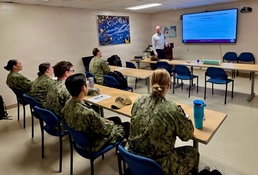
TWENTYNINE PALMS, Calif. — Sailors assigned to Navy Medicine Readiness and Training Command (NMRTC) Twentynine Palms completed National Institute for Occupational Safety and Health (NIOSH)-certified spirometry training on Feb. 26, expanding the command’s ability to detect occupational lung disease early and protect the respiratory health of service members and civilian personnel.
The three-day course provided hands-on instruction and certification for technicians responsible for conducting pulmonary function tests used to monitor respiratory health among personnel exposed to workplace hazards. Spirometry plays a critical role in occupational health programs by identifying lung function changes before symptoms develop, allowing for early intervention and improved outcomes.
Dr. Geoffrey Jacoby, occupational medicine physician at Branch Health Clinic Port Hueneme and course instructor, said the training focuses heavily on developing both technical proficiency and patient coaching skills necessary to obtain reliable results.
“The primary objective of the course instructor is to teach students how to coach patients through a complex set of respiratory maneuvers in a way that delivers accurate and reliable results,” Jacoby said. “Students learn to identify and correct testing errors, motivate patients to deliver their best effort, and help patients perfect their technique.”
Participants must complete the full three-day training and pass both a written and practical examination to receive certification as a NIOSH-certified spirometry technician, which remains valid for five years.
Jacoby’s background in occupational medicine spans decades of military service. During his Navy career, he supervised occupational medicine programs while serving as both a general medical officer and family medicine physician, later completing residency training in occupational and environmental medicine at the University of California, Irvine. He went on to serve in occupational medicine billets at Pearl Harbor Naval Shipyard, 3rd Marine Aircraft Wing and Naval Hospital Camp Pendleton before retiring from the Navy in 2020.
His experience across diverse military installations shaped his understanding of how workplace environments influence health risks.
“I like learning about peoples’ jobs and the various hazards that are unique to each job and work location,” Jacoby said. “Each military base has unique functions that determine what types of personnel and hazards are present.”
Spirometry testing serves as an important screening tool in occupational medicine programs, particularly for personnel exposed to respiratory hazards such as smoke, chemicals, dust and industrial materials.
“Spirometry is a screening test that can detect occupational lung disease in its earliest stages, often before symptoms develop and when interventions are most effective,” Jacoby said. “It can also be used as a surveillance tool for groups of workers such as aircraft painters or firefighters for early identification of health effects potentially related to workplace exposures.”
For military treatment facilities, maintaining in-house spirometry capability ensures continuity of care and allows providers to monitor respiratory health over the course of a service member’s career.
“It is essential for commands to have their own certified personnel to perform these tests as part of a comprehensive occupational health evaluation,” Jacoby said. “Longitudinal monitoring of patients over time is an essential component. We have been tracking some of our patients for more than twenty years.”
Results from each test are documented in the electronic health record and compared with previous exams to identify potential changes in lung function. This continuity allows providers across the Department of War to review historical data when service members transfer or deploy.
Lt. Cmdr. Matthew Horch, occupational medicine physician and department head for occupational health at NMRTC Twentynine Palms, emphasized the operational importance of maintaining a certified spirometry program at the command.
“This training allows us to fully comply with federal and Defense Health Agency regulations for conducting spirometry,” Horch said. “Without this training, we can’t perform spirometry, which is a critical component of any occupational health program for early detection of work-related pulmonary disease.”
Horch attended the training alongside his staff to better understand the technical process and support quality assurance efforts within the clinic.
“I think it’s important to understand how to properly conduct spirometry so that I can provide oversight and quality control of the exams performed in the clinic,” Horch said. “I can also help troubleshoot and advise when any of my technicians are experiencing difficulty with the exams.”
Having multiple certified technicians also ensures the program remains operational despite the frequent personnel movements common within military commands.
“Having several NIOSH-approved technicians at the command allows us to meet the mission even when our active duty staff move to other departments, go on temporary additional duty or deploy,” Horch said. “Spirometry is a critical tool for early detection of occupational lung disease, which can have significant costs to the patient and the organization if it is not caught early–so always having certified technicians on-hand is crucial.”
For junior Sailors, the certification represents both a professional development opportunity and a chance to play a more active role in patient care.
Hospitalman Apprentice Hanna Parkos, an occupational health technician assigned to the command, said the course provided a deeper understanding of both the technical and patient-care aspects of spirometry testing.
“Spirometry training teaches corpsmen how to properly perform, analyze and interpret pulmonary function tests,” Parkos said. “One of the biggest things I learned during the course is how much accurate results depend on proper coaching and technique. Paying attention to detail and giving clear instructions to the patient is critical to getting reliable data.”
Parkos said the certification will allow her to apply those skills directly in supporting occupational health monitoring for personnel working in environments where respiratory hazards may exist.
“With this certification, I’ll be able to monitor lung function changes over time by ensuring tests are conducted accurately and consistently throughout a patient’s career,” Parkos said. “Tracking those changes helps identify potential issues early so they can be addressed before they affect someone’s ability to perform their job.”
Monitoring respiratory health is particularly important for personnel who routinely operate in environments where smoke, fumes or industrial materials are present. Early detection helps ensure individuals remain healthy and capable of performing their duties safely.
“Monitoring respiratory function for personnel exposed to workplace hazards helps ensure they remain healthy and fit to perform their jobs,” Parkos said. “It protects both the individual and the overall safety and readiness of the command they serve.”
Beyond its diagnostic value, spirometry also provides corpsmen with opportunities to strengthen their patient communication skills while developing confidence in clinical settings.
Jacoby said the collaborative nature of the test makes it especially valuable as a training tool for junior Sailors.
“Spirometry is an ideal test for developing communication skills because it requires staff members and patients to work together to get the best results,” Jacoby said. “For junior corpsmen it can be a great opportunity to have their own patient schedule in the occupational medicine clinic, become actively involved in patient care and develop their bedside manner.”
The certification also offers long-term professional benefits for corpsmen by expanding their clinical skill set and enhancing career opportunities.
“This certification allows technicians to function more independently and take ownership of their patients and clinic,” Horch said. “It can also help with advancement within the military and future employment outside the military because it makes them more attractive applicants to employers.”
For Parkos, gaining a specialized skill that directly contributes to protecting the health of service members reinforces the core mission of Navy medicine.
“As a corpsman I take pride in learning new skills that support and protect our service members,” Parkos expressed.
Through initiatives like spirometry certification training, NMRTC Twentynine Palms continues strengthening its occupational health capabilities—ensuring Sailors, Marines and civilian personnel remain medically ready to support operational missions around the globe.