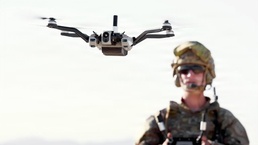
From Periscope to drone: Dogface Innovation changes the fight The 3rd Infantry Division’s Marne Innovations Center (MIC) fosters an environment for Soldiers of all backgrounds and ranks to create and test their solutions to real-world battlefield problems. U.S. Army Cpt. Jonathan Price and Sgt. 1st Class Scott Kibby, both from the 2nd Armored Brigade Combat Team, combined their knowledge and ideas to create the UAS Protection System (UPS), an affordable and accessible tool to alleviate the risk to Soldiers during combat.
On today’s modern battlefield, seeing the enemy first can mean the difference between victory and defeat. Two innovators from the 3rd ID’s MIC found a way to change how armored crews conduct reconnaissance by replacing a decades-old periscope with a 3D-printed device that puts a drone in the sky. Their invention, the UPS, gives crews a far wider view than the traditional mirror-based periscope while allowing them to control the drone from inside their vehicle—eliminating the need for a dismounted Soldier to operate it on the ground.
“The ability to keep Soldiers out of harm’s way while still accomplishing the same mission provides significant protection compared to having more Soldiers exposed on the ground.” said Kibby. Historically, a periscope would be inserted through a hole in the top of a Bradley and would utilize mirrors to see the surrounding area for mission analysis, while a dismounted Soldier used a tablet to control a drone hovering above. The UPS was created when Price and Kibby thought of a safer and more efficient way to conduct the same mission. “Detection matters the most to those that are closest to the enemy,” said Price. “So, we found out that the problem we wanted to address was ‘how do we reduce that at the user level—reduce the threat but maintain the capability.’”
The idea originated during a night iteration of training where Kibby’s Bradley was missing a periscope, and a Soldier was in the wood line with a tablet operating the reconnaissance drone. Kibby noticed that the brightness of the tablet could compromise their mission, so he instructed the Soldier to get into his Bradley, where he then controlled the drone by sticking the tablet through the hole where the periscope goes—resolving both problems.
Following the mission, Price and Kibby presented their idea to the MIC, where they were able to consolidate their equipment, 3-D print the concepts, and bring it to the field environment to test with 2 short weeks. Additionally, every part used is American made in the MIC, cost effective, and resourced very quickly, which enabled the UPS to be distributed and implemented into unit training at a rapid pace.
“The preservation of combat power and the protection of our Soldiers is our number one priority. Now that we have systems that take continuous skill to be able to operate, we must implement them rapidly, effectively, and multiple times.” Said Price. “With innovation across the battle space, we have to make sure we’re putting on those pieces of equipment in positions to be successful to achieve the result we are looking for.”
The MIC provides countless capabilities to ensure each Soldier is equipped with the resources needed to turn their ideas into reality. One of these capabilities—and one of the most prevalent—are the 3D printing machines. This technology provides flexibility in creating prototypes that can be customized to the user’s needs, which is how Price and Kibby refined their product by process of elimination.
“It was just an environment of like-minded people coming together trying to find that solution.” said Price. “Just being able to essentially play with Legos in a way of figuring out what works and what doesn’t.”
Now, the UPS is being implemented into formations across the division. With room to improve, the prototype has shown promising to the future of the 3rd ID’s battlefield tactics.
“I think it’s a testament to the U.S. Soldier and their ability to receive both equipment or a problem, and see how they can find a solution,” said Price. “It’s a direct testament of how the new generation is extremely good at finding trends, and it allows them to develop solutions faster.”