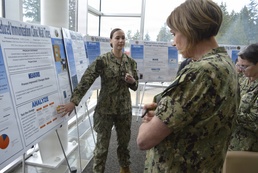
When Dr. Audra McCoy explained fiscal oversight importance for prescribed medications, the Defense Health Agency responsibility to operational readiness as a combat support agency became further defined.
McCoy, on behalf of Branch Health Clinic Everett Pharmacy and their ‘Pharmacy Best Practices: Eliminating Costly Errors with High-Cost Drugs’ presentation, was one of 15 participants at the annual Naval Hospital Bremerton Continuous Process Improvement Fair held March 12, 2026.
“Our pharmacy team has noticed a huge increase in prescription cost. To lower that cost, we’ve been successful in working with the provider and the patient,” said McCoy, addressing interested participants and attendees at the fair, noting that managing high-cost medications requires increased scrutiny, as even minor errors can directly impact treatment and bring about financial risk. Minimizing any such risk is key.
“We developed strategies to prevent dispensing errors, pursue cost savings and improve procurement and storage issues,” McCoy added. “We’ve cut the cost of some meds in half, saving our tax-payers thousands. But it’s a challenge. Having our smart young [pharmacy] technicians involved means it can take them minutes to recognize cost saving options and opportunities what usually takes me hours to identify.”
Along with McCoy as project lead, the Everett Pharmacy team included Kathy Scott, Sonny Wilson, Latoya Hall, Hospital Corpsman 1st Class Michael Piepryzk, Hospital Corpsmen 2nd Class James Bryanshock and Anthony Winsor, and Hospital Corpsmen 3rd Class Isabelle Doyle and Tate Felipe-Caton.
Ideas on environmental stewardship, upgrading space utilization, patient-care improvement and more were on display.
“Every year we host a CPI Fair to give our staff a chance to showcase amazing improvements they are making in their areas. For our staff who have participated in the Lean Six Sigma Green Belt course over the last year, it also gives them a chance to share the project(s) that they are working on toward their certification,” said Lt. Cmdr. Ashley Gripe, command process improvement sciences lead and organizer of the fair. “Every staff member has valuable input and ideas that can improve our processes throughout the Military Health System. When they engage in process improvement it not only helps our beneficiaries and staff, but it also helps the members see how their contributions really make a difference to the overall mission.”
The Surgery Department demonstrated their ‘Surgical Smoke Plume Evacuation.’ Project lead HM1 John Palmer – and Lt. Ibrahim Akano – on behalf of Main Operating Room and Anesthesia staff, stated that surgical smoke is generated when tissue vaporizes from the use of energy-generating devices, resulting in toxic gases and vapors which can be hazardous to patients and perioperative staff members.
“Using some surgical tools can be like inhaling smokes from three cigarettes in 15 minutes and inhaling smoke from six cigarettes in the same amount of time,” said Palmer.
The staff implemented a plan to reduce surgical smoke, which was recently recognized by the Association of Perioperative Nurses with the AORN Go Clear award.
The Ambulatory Procedure Unit, with project lead Lt. Rowena R. Gilmore and team members Cmdr. Marissa Hesse, HM1 Daniel Avetu and the rest of the APU team, presented ‘Streamlining Phase II Discharge through PACU Integration.’ There was a need to maintain and improve upon patient care and quality of care with reduced staffing levels which have strained resources and limited operational efficiency. Patient flow was optimized, discharge processes enhanced and nurse staffing flexibility was increased.
Ophthalmology Clinic staff and project lead Erick Brendon presented ‘Sharper Vision, Stronger Mission – Supporting Warfighters Worldwide.’ NHB’s Vice Admiral Richard Nelson Refractive Surgery Center is timely capable of providing corneal refractive surgery options such as PRK, LASIK and SMILE to active-duty personnel for the entire Defense Health Network Pacific Rim area.
“We’ve already scheduled two patients from Japan. Our clinic has the shortest wait time for corrective eye surgery. Other places have a one to two year wait. Our wait time on average is about one month, with all the paperwork done beforehand [[https://bremerton.tricare.mil/Health-Services/Vision/Ophthalmology](https://bremerton.tricare.mil/Health-Services/Vision/Ophthalmology)],” said Brendon, stressing that by efficiently scheduling surgeries it allows personnel to quickly return to duties with minimal downtime.
“Expanding our services to provide correction surgery across the Pacific also helps to reduce their need on corrective lenses and really enhances overall mission readiness,” Brendon said.
The Informatics Steering Committee, with project lead Lt. Hana Omodt and team members Lt. Christopher Gunderson, Mr. Kelly Gann, Mr. Chris Rona and Mr. Adam Richard, presented ‘MHS GENESIS Account Request Process,’ noting that coordination between staff and the centralized contracting team is imperative. Any unfamiliarity of proper process protocol and lack of adequate communication can cause confusion, frustration and delays in account activation.
Their project called for identifying the challenges, reduce processing time, decrease rejection rates and improve staff satisfaction with a toolkit being developed to assist in their project.
Lt. Cmdr. Soah “Amy” Chon took a brief pause from her Primary Care Clinic duties as Immunization Clinic and Operational Readiness Clinic division officer to explain their straightforward presentation of ‘Keep Clear.’ With patients seeking care from several clinics all converging in one area, there are times when access to care was getting obstructed. A plan was put in place to keep passageways and doorways clear and prevent any potential patient and staff safety incidents.
The Perioperative APU presented ‘Ambulatory Procedure Unit’s Readiness Checklist,’ with team member HM3 Nicholas Metaxas sharing that the preoperative staff continually verifies all scheduled surgical patients remove any jewelry, contact lenses and especially [body] piercings. Without doing so causes surgery delay as well as Main Operating Room staff frustration.
“A standardized set of check-in questions has been developed, with a check-off sheet attached to each patient’s chart before surgery,” said Metaxas. Also involved in the project were project lead Annette Elmore and Robyn Hopper-Burrell.
The Anesthesia team presented ‘Ready Reliable Care: An Anesthesia Technician Initiative,’ with team member Tina Cabana speaking on behalf of project leads Capt. James Birkla, Cmdr. Marc Silfies and team members HM1 Daniel Avetu and HM2 Matthew Escobar.
Any turnover with anesthesia technicians causes a knowledge gap which could compromise surgical case readiness and procedural efficiency and directly impact patient safety. The anesthesia providers identified specific deficiencies and developed baseline performances metrics, which included updating anesthesia tech personal qualification standards.
“We’re also teaming any new tech with an experienced staff member,” said Cabana.
The Allergy Infusion Clinic, with project lead Gilmore and team members Tess Valle, Hesse, Avetu and the APU team presented ‘Allergy Infusion Clinic’s Big Move Initiative,’ which was predicated in the clinic’s previous locale being inadequate to handle staff as well as patient flow. It created overcrowding and potential infection control risk. By relocating to a new room, the infection risk was reduced, reliance on other medical equipment was minimized and staff morale and comfort was improved.
‘Elimination of Aerosol Spray’ was presented by Surgery and Main OR, with HM1 Domenick Llanda project lead and team members Lt. Cmdr. Kellie Haney, Chief Logistics Specialist Steve Gardiner, HM2 Victoria Perez and other Main OR Sailors.
“We’re unnecessarily paying to dispose of empty aerosol cans of enzymatic solutions. Our goal is to phase out the current stock of those aerosol cans and replace with non-aerosol versions. It cuts down on storing hazardous material and saves money which was going down the drain,” Llanda said.
Mental Health Directorate, with project lead Lt. Cmdr. Trinity Dunham and team member HM2 Cade Crenshaw presented ‘Augmentation of Mental Health Access to Care Through Virtual Platforms.’
“We recognized the opportunity to reduce access to care for active duty. The latest data reflects we had an average ATC of 11 days, which meets the DHA 28-day standard and is well below the network 33.9-day average for an initial evaluation,” said Dunham.
Two mental health virtual platforms launched were advertised in a targeted Mental Health campaign to Sailors with compiled data showing increased utilization with the virtual mental health resource options.
Project lead Lt. Ellen Thomson of Navy Medicine Readiness Training Unit Everett represented team members HM3 Dolce Bianca McCarrel, HM3 Zechariah Albright, HM3 William McGee, HM3 Trevor Talkington, HM3 Khristine Ocampo, and Dr. Renata Lukezic in their ‘Reduced Immunization Clinic Wait Times’ project. The current check-in method at the clinic for any beneficiary was causing longer way times leading to patient dissatisfaction.
“We edited our clinic signs and added a pager notification system which really helped decrease patient wait times,” Thomson said.
‘Global Electronic Approval and Routing System’ by Specialty Care with project lead Lt. Justin Roelofs and team members Lt. Sarah Begley and HM2 Rebekah Feltman focused on the problem of how relying on a manual, paper-based routing method can create critical mission risk, with added exasperation from untraceable delays, misplaced and lost documents. Converting to a fully automated system will create a transparent, trackable and timely system.
NMRTU Everett Dental Clinic presented ‘Dental Referral Tracking,’ with project lead HM1 Ryan Johnston and team members Lt. Ian Berude, HM2 Samuel Vasquez and Hospitalman Maki Gilbert. The clinic team was faced with an inability to track dental care referrals which led to unconfirmed treatment completion and unknown patient health outcomes. A standardized process was implemented to effectively and efficiently track dental care documentation of active-duty personnel, leading to better fleet deployability.
The Internal Medicine Clinic fair submission, ‘Reducing Provider Burnout,’ was presented by project lead Mr. Aaron Myers, in conjunction with team lead Cmdr. Samantha Jennings and team members Lt. Cmdr. Levis Tran, Lt. Jonathan Hickman, Omodt, HM3 Michael Doyle and HM3 Dominic Riley Herrod. Providers’ non-direct patient care tasks were causing overutilization. By standardizing workflows with support staff to handle clinical tasks, the goal is to help alleviate the concern.
Along with the static display poster boards set up on the command’s quarterdeck, the presentation projects also went virtual which enabled staff at the branch health clinics located on Naval Base Kitsap Bangor, Naval Station Everett and Puget Sound Naval Shipyard to participate and vote.
“The fair gives us an opportunity to hear about process improvements that we may not have otherwise heard about. This inspires creativity in other areas and overall adds to our culture of continuous process improvement and commitment to being a high reliability organization,” remarked Gripe. “I have organized the CPI Fair for three years now and every year I am impressed with the creativity and dedication of our staff. In every area of our hospital and clinics you see how staff of all ranks and roles are making both small- and large-scale process improvements that make a big impact on our staff and beneficiaries.”