BEMOWO PISKIE TRAINING AREA, Poland — The thunder of tank fire and the crack of machine guns echoed across the training area as Soldiers from 3rd Battalion, 8th Cavalry Regiment executed a combined arms live fire exercise, marking one of the final major training events of their nine-month rotation deployed in Poland.
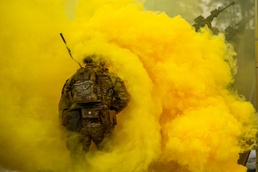
Thick clouds of smoke hung over the impact area as Bradley Fighting Vehicles lined the range, maneuvering through the training lane while crews scanned the battlefield and communicated across the formation during the battalion’s culminating live fire event. Romanian Gepard air-defense systems maintained aerial security behind the formation while British soldiers supported communications across the battlegroup. The training area reflected months of maneuver training across frozen ground, mud, and forested terrain.
The Combined Arms Live Fire Exercise represents the culmination of months of progressive training conducted across the region in support of NATO’s enhanced Forward Presence Battlegroup Poland, part of the alliance’s Forward Land Forces mission along the eastern flank. Throughout the rotation, the Warhorse battalion trained alongside allied forces to sharpen combat lethality, strengthen multinational interoperability, and refine the tactical skills required for large scale combat operations.
“Training alongside American and British forces during exercises such as STX, FTX and live fire events provided an important opportunity to exchange experience and strengthen interoperability across the battlegroup,” said Capt. Elena Glineschi, Romanian Air Defense Artillery Battery commander. The captain’s response perfectly mirrored NATOs desired result of ensuring the allied troops get multiple opportunities to train together, “Through these activities, we improved coordination between our units and demonstrated that teamwork is essential to accomplishing our mission. Together, we are stronger.”
The battalion’s deployment began long before firing a single round in Poland. Multiple hours and days went into planning the movement of every single piece of U.S. Army heavy metal. Equipment ranging from M1A2 Abrams tanks and Bradley Fighting Vehicles to artillery systems and support vehicles were transported from the United States and moved across Europe by rail and convoys into Poland, demonstrating the Army’s ability to rapidly project and deliver armored combat power to NATO’s eastern flank.
Almost immediately after the first boot hit the ground, Soldiers went to straight to work. The troops from 3rd Battalion, 8th Cavalry Regiment participated in Exercise Iron Defender in September 2025. The exercise brought together allied forces from across Poland to rehearse a large-scale combat operation to reinforce NATO’s defensive posture along the alliance’s eastern flank.
Throughout the fall, units across the battalion focused on building combat proficiency through progressive training events, each event built on the success of the one before. In November 2025, artillery crews from 1st Battalion, 5th Field Artillery Regiment conducted gunnery tables to refine their ability to deliver accurate fires in support of maneuver forces, while tanks and Bradley crews continued sharpening their skills at operating armored platforms across muddy maneuver lanes and forested training areas.
During the same period, U.S. Army engineers conducted abatis training after receiving approval from Polish forestry authorities to remove trees within designated training areas at Bemowo Piskie Training Area. Using controlled demolitions, engineers felled trees to create obstacles designed to slow or disrupt enemy movement while practicing battlefield mobility and counter mobility techniques.
Following these training events, the rotation moved into the winter months as Soldiers continued operating across northeastern Poland. Winter brought the harshest conditions of the deployment. By January, temperatures around Bemowo Piskie dropped well below freezing, at times nearing negative 20 degrees Celsius as snow and ice covered the training areas. Despite the cold, Soldiers continued training and maintaining equipment in the open air, while others ran along icy roads bundled in layers of cold weather gear to maintain their physical readiness.
The battalion also participated in the expansion of NATO’s enhanced Forward Presence Battlegroup Poland as part of the alliance’s Forward Land Forces initiative. The effort increased the battlegroup at Bemowo Piskie from a battalion sized element to a brigade level formation. As part of the expansion, hundreds of Soldiers and three hundred pieces of armored vehicles and equipment, including Abrams tanks, Bradley Fighting Vehicles and support platforms like ambulances, were moved by rail and convoyed across Poland to the training area. The large movement demonstrated NATO’s ability to rapidly reinforce the eastern flank and integrate multinational combat power in a contested environment.
As training intensified across the battlegroup, mortar teams played a critical role during exercises throughout the rotation.
“The 3rd Battalion, 8th Cavalry Regiment mortar platoon supported every maneuver company during platoon and company collective qualifications throughout our rotation in Poland,” said 1st Lt. Nate Charron, mortar platoon leader. “From operating in frozen terrain in January to navigating the thaw and mud in March, the platoon adapted to difficult conditions while maintaining our vehicles and maneuvering between firing positions.” Charron went on to praise his mortar platoon’s adaptability and professionalism in such challenging conditions, “they executed more than 45 live-fire missions in an environment unlike what we experience at Fort Hood,” he said.
The mortar platoon leader made it a point to speak on the initiatives of both his junior non-commissioned officers and enlisted Soldiers. “The platoon’s growth reflects the discipline and resilience of our junior leaders, as many specialists and sergeants stepped into positions above their pay grades to ensure mission success,” Charron said.
Mortar crews regularly fired high explosives, and illumination rounds in support of maneuver elements, lighting the sky above Bemowo Piskie Training Area long into the night during training operations.
Training alongside NATO allies remained constant throughout the deployment. Snipers from the U.S. Army and the United Kingdom trained together during joint exercises, sharing tactics and techniques and strengthening their ability to operate as a combined force across the battlegroup. “Working alongside our U.S. partners has been extremely valuable,” said a British Army sniper commander with the ISR Group, 2nd Battalion, The Royal Anglian Regiment, whose name is withheld for operational security reasons. “It allows us to exchange experience, refine our skills and maintain the high standards expected of sniper operators. It’s been particularly rewarding to see British students helping develop and support U.S. personnel as they prepare to attend sniper school in the United States. Their attitude and enthusiasm have been exceptional.”
As the deployment progressed, Soldiers conducted increasingly complex training events designed to build proficiency at every level of combat operations. In February, engineers completed their Table VI qualification before platoon situational training exercises advanced from dry rehearsals to blank fire scenarios and finally, to live-fire engagements as armored vehicles maneuvered across the training area while infantry elements moved between fighting positions.
The Combined Arms Live Fire Exercise represents the culmination of months of training, bringing together tanks, infantry, artillery and supporting elements in a coordinated battlefield scenario as the final rounds echoed across the training area.
Through months of rigorous training alongside NATO allies, Soldiers from 3rd Battalion, 8th Cavalry Regiment demonstrated the readiness required to support the Forward Land Forces mission and reinforce deterrence along NATO’s eastern flank.