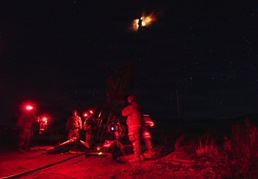
White Sands Missile Range, N.M. - (Editor’s Note: The images accompanying this story are not from the DIESEL experiment but represent technologies and activities like the events that took place over the four weeks of DIESEL.)
Teams across the Army, Joint Force, Special Operations Forces, multinational allies and partners, and industry converged on White Sands Missile Range, N.M., to assess, develop, and reassess technology during the Denied, Degraded, Intermittent, and Limited Bandwidth Integrated Environment Supporting Experimentation & Learning event known as DIESEL 26. The DIESEL Team built upon seven years of success from previous DDIL experiments to plan, develop, and execute this year’s event in less than six months.
The experiment began Feb. 23 with more than one thousand participants testing and experimenting with over 100 technologies inside a full spectrum contested environment. As the Army’s premier live-sky, open-air GPS and communications denied/degraded experiment, DIESEL offers pacing-threat-informed tactical scenarios where new and existing technologies are assessed, developed, and reassessed in some of the most challenging and realistic environments available.
“Our experimentation events have been critical to advancing Army transformation efforts. Seven programs of record have utilized our DDIL environments to test and mature technologies that are now in the hands of Soldiers,” said Jason Joose, DIESEL deputy chief. “DIESEL directly complements and informs the Cross-Domain Fires Concept Focused Warfighting Experiment by providing a contested environment where we can test, refine, and integrate technologies that increases the delivery of precise and synchronized effects across domains. The lessons learned here directly enhance the Army’s ability to converge fires faster and with greater lethality.”
Supporting Army transformation and CDF CFWE
DIESEL is a complementary experiment that directly supports the Army Transformation Initiative and aligns with U.S. Army Futures and Concepts Command’s Concept Focused Warfighting Experiments, including the Command and Control/Counter-Command and Control and Cross-Domain Fires, by task, terrain, tech, and time. CFWE’s are designed to translate warfighting concepts into war-winning capabilities by blending live and distributed experimentation across command and control, cross-domain fires, expanded maneuver, and human–machine integrated formations.
“By feeding data and insights from DIESEL directly into the Cross-Domain Fires CFWE, we ensure that real-world experimentation continues to shape future concepts and capabilities,” said Joose. “DIESEL bridges concept and capability, translating experimentation into operational readiness for the future force.”
The CDF CFWE will capture insights and recommendations from DIESEL and other linked events, ensuring they inform the continued refinement and operationalization of the Army Warfighting Concept and the design and delivery of the future force. Additionally, DIESEL insights trace to the Future Study Program, Future Concept Experiments, Joint Warfighting Assessments, and other FCC experiments that make up the Army’s broader Campaign of Learning.
Realistic DDIL environment at WSMR
DIESEL provides the DDIL environment needed for participants to test integrated systems that operate in various regions of the spectrum and truly understand their capabilities in a realistic setting. While other experiments at the National Training Center, Joint Readiness Training Center, and other locations can incorporate DDIL activities, WSMR uniquely provides an open-air environment to replicate and emulate advanced threats the force may face in the future.
DIESEL addresses requirements and capabilities that support cross-domain fires, non-kinetic effects, deep sensing, command and control, maneuver, and formation-based layered protection. It does this by providing an operationally realistic threat environment in which to observe and analyze the performance of a wide range of multi-domain technologies across three primary vignettes: Target Discovery in an A2/AD environment, Convergence of Effects, and Formation-Based Layered Protection.
“In modern warfare, connectivity is combat power. DIESEL’s integrated environment allows us to see how systems communicate, share data, and synchronize effects when networks are denied or degraded,” said Joose. “Those insights drive true integration—where sensors, shooters, and command systems operate as one cohesive force despite persistent disruptions.”
Decision advantage and the human element
As seen in previous FCC experiments and more recently the 4th Infantry Division’s Ivy Sting exercises, the network is the foundation for many of the activities driving these events. Soldiers, sensors, and weapon systems on the battlefield must be able to feed information into coherent mission systems, so commanders maintain decision advantage in multi-domain and large-scale combat operations.
“In the complex environment of multi-domain operations, decision advantage comes down to how quickly commanders can sense, understand, decide, act, and assess. Technology gives us speed and reach, but decision advantage still comes down to commanders—how fast they process information in complex environments. DIESEL enables us to test our sensing systems, and their data backhaul dynamic under true operational stress, ensuring we can make decisions faster than our adversary,” Col. Pat Moffett.
Participants at DIESEL see how their equipment and technology operate in one of the most realistic full-spectrum contested environments available. When challenges arise, they can develop solutions and refine Tactics, Techniques, and Procedures that are vital to future mission accomplishment.
Connectivity, integration, and future readiness
Dependency on technology is quickly realized when systems fail due to cyberattacks, GPS jamming, or communications disruption—conditions intentionally replicated at WSMR. With a focus on counter-sensing, command and control, electromagnetic warfare, navigation, cyber, and communications, DIESEL is vital to the Concept Focused Warfighting Experiments and to building resilient, integrated formations.
“Utilizing the conditions at WSMR, we created a DDIL environment that lets us push integrated systems to their limits and truly understand how they perform when it matters most,” said Joose. “Experimentation in DDIL environments is not new to the Army—but DIESEL scales that effort, bringing together everyone from Soldiers and scientists to joint, allied, and industry partners in one place to accelerate learning and modernization.”
Everyone is here—Soldiers, civilians, joint and multinational teammates, and industry partners—working side by side to ensure the Army can fight and win in the most contested environments of the future.
Way ahead
Persistent experimentation is critical to Army transformation, allowing for deliberate learning, training, and warfighting system interoperability. Coupled with Soldier feedback and training in realistic, threat informed operational environments, live-sky experiments are poised to advance broader transformation priorities through nested learning demands.
Experiments in denied, spectrum-degraded environments help the Army close the gap between today’s efforts and tomorrow’s warfare, evaluating capability readiness and adaptability.