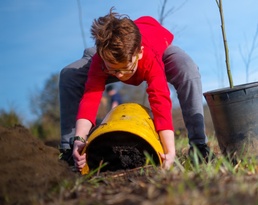
WARRENTON, Ore. — Shovels hit the ground and native trees went into the earth along Neacoxie Creek at Camp Rilea March 14 as volunteers from Scouts BSA Troop 258 joined Oregon Military Department environmental staff in support of National Public Lands Day.
The event was part of a nationwide effort organized by the National Environmental Education Foundation, known as NEEF, which makes grants available to Department of Defense installations to support natural and cultural resource stewardship projects. This year, more than 56,000 volunteers participated in over 900 events across the country.
For Oregon Military Department Natural Resource Specialist, Rhande Shaw, the timing couldn't have been better. When she learned Scout Troop 258 of Canby, Oregon was already on post for their annual campout, she reached out to the troop Committee Chair, Dan Cushman and asked if they'd be willing to spend part of their visit working on a community project.
"He jumped on it immediately and said, 'Absolutely, we want to give back,'" Shaw said.
The scouts, ranging in age from 11 to 17, began the morning with an educational presentation on Camp Rilea's mission, its natural and cultural resources, and the importance of riparian ecosystem health before picking up tools and getting to work.
The team planted approximately 120 native trees and shrubs along roughly 1,400 feet of Neacoxie Creek, including about 75 red alder, 19 Pacific crab apple, and 16 spirea. The species were selected for their ecological value and cultural significance red alder has been used by local indigenous tribes for centuries as a source of food, dye, medicine, and ceremonial materials.
The work addresses a growing problem along the creek. Years of invasive species encroachment, particularly Scotch Broom, combined with erosion have degraded the riparian zone, affecting water quality and wildlife habitat. By reestablishing a native plant corridor, the project aims to stabilize stream banks, reduce sediment runoff into Neacoxie Creek, and improve conditions for pollinators, birds, and riparian species throughout the installation.
Shaw noted the benefits extend well beyond the creek bank.
"If we're improving the water table, it can support the violets that the Oregon Silverspot Butterfly relies on," she said. "So it's that bigger picture — protect this, and it's the domino effect."
The Oregon Silverspot Butterfly is a threatened species that depends on coastal prairie habitat, some of which exists along the Neacoxie corridor. Camp Rilea is also open to recreational visitors, and the restored riparian zone is expected to enhance the visual character of the area enjoyed by campers and lodging guests.
Cushman said the scouts were glad to contribute. Each participant received community service hours toward their next rank advancement.
"We camp here every year," Cushman said. "This was a really neat opportunity for them."
Shaw said the scouts made the most of it.
"I'm really impressed with how well they've all worked together," she said. "They were gung-ho and ready to go."
The project was funded through a NEEF grant of $2,440.84 awarded to the Oregon Military Department. Site preparation — including removal of remaining Scotch Broom, marking planting locations, and procuring plant materials — was completed in the weeks prior to the event.
For the Oregon Military Department, the project reflects a broader commitment to protecting the lands that sustain the mission.
"If we can protect our resources and keep things as native as possible, that protects our mission," Shaw said.