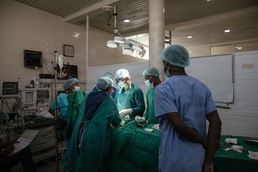
DAR ES SALAAM, Tanzania – U.S. and Tanzanian medical professionals completed the first-ever medical readiness exercise at Lugalo General Military Hospital and Msata Military Training Base, Tanzania, March 2-12. The mission served as an operational component of Justified Accord 2026, U.S. Africa Command's largest exercise in East Africa.
Led by the U.S. Army Southern European Task Force, Africa (SETAF-AF), JA26 focused on readiness, innovation and crisis response. The MEDREX advanced those priorities by testing U.S. medical proficiency in austere, resource-constrained environments and supporting the Nebraska-Tanzania State Partnership Program.
The joint medical team integrated professionals from U.S. Army and U.S. Air Force units from the Nebraska National Guard and active-duty forces. The team treated more than 800 patients across 10 distinct medical specialties, including trauma surgery, infectious disease, orthopedic surgery, optometry and pediatrics.
Tanzanian partners identified the required capabilities, shaping the U.S. medical team's composition.
"We collaborate with the host nation about the types of specialties they prefer," said U.S. Air Force Lt. Col. Angela Ling, a medical officer assigned to the 155th Medical Group, 155th Air Refueling Wing, Nebraska Air National Guard. "It's not just what Nebraska has available, it's what they need and desire, and then how do we improve readiness by fulfilling their needs."
Providing these tailored, host-nation requirements ensures U.S. forces increase their technical proficiency and advance the interoperability required for rapid crisis response. This training promotes shared responsibility and positions African partners to achieve operational independence and lead regional security efforts.
About 20 U.S. military medical personnel provided care alongside Tanzanian counterparts at Lugalo General Military Hospital. Meanwhile, a smaller joint team deployed to the remote village of Msata, testing medical decision-making under severe resource constraints.
Treating unfamiliar regional illnesses, such as malaria, provides military physicians with hands-on experience they cannot replicate in standard U.S. treatment facilities.
"Operating in this austere environment forces us to rely on our foundational clinical skills and adapt to logistical constraints," said U.S. Air Force Col. Halton Beumer, an ear, nose, throat and facial plastic/reconstructive surgeon assigned to the Surgical Operations Squadron, Brooke Army Medical Center, Fort Sam Houston. "The interoperability we build here directly translates to our own operational readiness, ensuring we are prepared to deploy and provide trauma care anywhere in the world."
Such field training ensures medical units remain tactically prepared to support large-scale combat operations globally.
“At home station, our main priority in the National Guard is ensuring that our Airmen are medically ready to deploy, and then also maintaining our readiness," said U.S. Air Force Col. Brooke Sciuto, family medicine physician and commander of 155th Medical Group, Nebraska Air National Guard. "Here, we have the great opportunity to provide care and practice our readiness skills."
The exercise also functioned as a battle lab for the total force. The U.S. Army tested a digital field-medicine tracker for the first time in Africa to quantify operational readiness. Providers logged encounters, procedures, diagnoses and clinical hours through a mobile interface.
Developed by the U.S. Air Force, the Medical Currency Application for Readiness Tracking 2.0 is a cloud-enabled, modular system. The platform aggregates clinical data and adds calculated measures like work-relative value units, as well as joint knowledge, skills and abilities metrics, then populates a near real-time dashboard accessible to leadership.
"The most significant improvements came from the hundreds of end users across the Army, Navy and Air Force who tested the application during operational missions and exercises," said U.S. Air Force Col. Justin Fox, professor of surgery at the Uniformed Services University of the Health Sciences. "Their feedback was critical in improving usability and ensuring the platform met the practical needs of clinicians operating in real-world environments."
The platform's ongoing success relies on continuous user-driven feedback from the field. Testing by end users during the exercise ensures the application meets the practical needs of medical personnel.
By synchronizing the state partnership, specialized clinical expertise and digital innovation, this historic MEDREX validated U.S. medical readiness and reinforced the operational value of partnered training in East Africa.