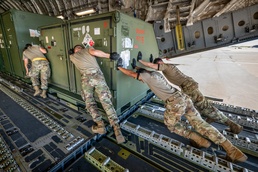
Aerial porters, civil engineers, cybercommunications specialists and vehicle mechanics were among more than 70 Kentucky National Guard Airmen who trained with their active-duty, civilian and Hawaii Air Guard counterparts here recently to improve base operations, staff an air cargo terminal and enhance their global employment as Multi-Capable Airmen.
The troops, all from the Louisville, Kentucky-based 123rd Airlift Wing, built a command post, repaired pavement, upgraded more than 300 computers, serviced material handling equipment for crucial airlift missions, processed 455 short tons of air cargo, moved 1,661 passengers and pumped 142,500 gallons of jet fuel as part of five exercises between July 26 and Aug. 9.
Those exercises were Nodal Lightning, Northern Edge, Pacific Sentry, Talisman Sabre and Mobility Guardian, the largest air mobility exercise in history, according to Lt. Col. Matthew Skeens, commander of Kentucky’s 123rd Logistics Readiness Squadron.
“Our aerial porters were tasked with directly supporting Mobility Guardian, but everybody on this deployment facilitated the global airlift mission trough their unique specialties,” Skeens said. “This team of over 70 folks was truly at the tip of the spear as it relates to air mobility.”
Maj. Brent Lasher, who served as Kentucky’s officer-in-charge during the deployment, said the experience proved invaluable.
“Working side-by-side with active-duty specialists and joint partners gave our Airmen the opportunity to operate in a fast-paced environment,” he said. “It helped sharpen critical skills specific to career fields while reinforcing the teamwork needed for joint operations.
“That directly contributes to our mission readiness. Our Airmen came home more capable, confident and aligned with the standards expected in joint and coalition environments, strengthening our Total Force integration and ensuring we’re always ready to respond when called.”
Airman 1st Class Beau Barker appreciated the opportunity to load cargo on a wide range of aircraft seldom seen at home station, including Boeing 757s and KC-46 Pegasuses, while operating more capable material handling equipment like a 4K forklift or the Tunner 60K Cargo Loader, which dwarfs the 25K Halvorsen Cargo Loaders used in Louisville.
“I’ve had the opportunity to load and offload a lot of aircraft we don’t see back home, and get experience with equipment like the 4K forklift, which I’ve never driven before,” said Barker, an aerial porter and one of about 20 deployers from the 123rd Logistics Readiness Squadron.
“You get to work with a higher volume of cargo here, too, and the process is different than we use at home with our C-130s. Different aircraft configurations come into play, and they have more automated handling equipment.
“This kind of training definitely makes me a better, more capable Airman. I can go anywhere in the world and work on any plane. But the best experience I had was meeting and working with all my active-duty, civilian, Guard and reserve coworkers to create a connection with the people here. It helps boost morale and wanting to give the job everything you’ve got.”
The deployment was equally rewarding for Airmen from other specialties like civil engineering and communications.
“They have a lot more heavy equipment here than we do at home station, and the work they do is a lot more varied,” said Tech. Sgt. Patrick Lawrence of Kentucky’s 123rd Civil Engineer Squadron. “Their parking apron is phenomenally bigger than ours, for example, and this is also a historical site, so they have to work within certain historical constraints as well.”
Lawrence and 17 other Kentucky engineers expended nearly 1,300 hours working side-by-side with their active duty counterparts to construct a command post, repair generators, complete dozens of electrical and plumbing work orders, install air conditioning systems, spread 25 tons of asphalt pavement, and protect 30 historic World War II-era homes from environmental degradation by hanging 4,000 square feet of plywood.
“Those things all made this deployment a great training opportunity,” he said. “We had a lot of hands-on training experience, and we got to work with the Army and Navy, so it was good joint operations for us, too.”
Tech. Sgt. Nathalie Rice, one of 10 Airmen from Kentucky’s 123rd Communications Squadron, spent the deployment helping upgrade more than 300 laptop computers to run new software, saving the Hawaii Air National Guard hundreds of thousands of dollars in replacement costs.
“I love working on hardware,” Rice said. “I don’t get to do it often enough back home, so this was a great training opportunity for me.”
Lasher said the skills honed in the Pacific will pay dividends for years to come as Kentucky Airmen continue to deploy around the world.
“I’m incredibly proud of the professionalism and flexibility our teams showed throughout this mission,” he said. “This wasn’t just a training opportunity — it was a step forward in building the future of agile air mobility.”