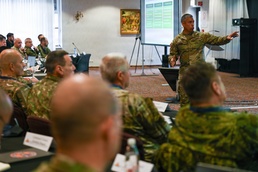
GRAFENWOEHR, Germany – The 7th Army Training Command hosted the annual Conference of European Training Centers (CETC), March 12-13, 2026, bringing together military leaders and training professionals from across NATO allied and partner nations to strengthen multinational training and readiness across Europe.
The conference provides a forum for commanders and training experts from combat training centers across the European theater to build relationships, exchange best practices, and align training approaches designed to improve interoperability across the NATO Alliance.
“The question we’re all trying to answer is simple: what does this mean for our formations and our countries, and how do we turn strategic guidance into something that actually works on the ground,” said Brig. Gen. Terry Tillis, 7ATC commanding general. “No one nation has the full answer, which is why bringing our training centers together is so important.”
This year’s conference focused on aligning multinational training efforts with evolving operational concepts designed to strengthen NATO deterrence across the European theater.
“The Eastern Flank Deterrence Initiative (EFDI) is really about connecting the entire system,” said Tillis. “It’s sensors, data, analysis, and then a response - whether that’s artillery, aviation, rockets, or unmanned systems. The challenge is making sure every nation’s capabilities can communicate and operate together.”
Leaders attending the conference discussed ways to synchronize multinational exercises, integrate emerging technologies into training environments, and better prepare Allied forces to operate together in complex operational scenarios.
For many participants, the urgency of improving collective readiness reflects the rapidly evolving security environment in Europe.
“The battlefield has changed rapidly in the last few years, and the threat has evolved just as quickly,” said Col. Karst Brandsma, chief of the Commander’s Initiative Group for U.S. Army Europe and Africa. “That sense of urgency is why efforts like this conference matter so much. We cannot afford to wait to build the capabilities and partnerships required to defend the alliance.”
Brandsma shared a personal experience from a visit to Lithuania shortly before Russia’s 2022 invasion of Ukraine, highlighting the historical context that continues to shape security concerns across Eastern Europe.
“I walked through a former KGB interrogation facility that had been preserved as a museum,” said Brandsma. “Seeing schoolchildren walking in behind us for a field trip reminded me that the security of this region isn’t abstract—it’s about ensuring those generations never have to experience that kind of oppression again.”
During the conference, leaders also discussed operational concepts such as the EFDI, which focuses on integrating sensors, data networks, and weapons systems across the Alliance to improve decision-making and battlefield response.
“At its most basic level, the EFDI is an operating concept designed to help deter—and if necessary, defeat—a modernized threat alongside NATO’s borders,” said Lt. Col. Sam Rosenberg, branch chief at USAREUR-AF. “It connects sensors, data, and weapons systems so commanders can make decisions faster than an adversary.”
A key component of that effort is the development of a digital network capable of linking sensors and weapons systems across multiple domains.
“The digital backbone is what connects everything,” said Rosenberg. “It links sensors to the best available effects and gives commanders the ability to analyze information and respond faster than the enemy.”
Throughout the conference, participants emphasized the importance of training environments that allow Allied forces to experiment with new technologies and integrate capabilities such as unmanned systems, electronic warfare, and advanced sensing platforms into multinational exercises.
“All of this technology only matters if our Soldiers can train with it,” said Tillis. “We have to create training environments where units operate with unmanned systems, electronic warfare, and modern capabilities at scale so they’re prepared for the fight they may actually face.”
By bringing together leaders responsible for training across Europe, the CETC continues to strengthen professional relationships and align training priorities across the alliance.
“Every country represented here sees the challenges from a slightly different perspective,” said Tillis. “Our goal is to create a common language, a common purpose, and training systems that allow our forces to fight together as an Alliance.”
The 7ATC provides live, virtual and constructive training for U.S., allied and partner nations in support of USAREUR-AF. The command resources training readiness for all of USAREUR-AF’s assigned and allocated forces through the Joint Multinational Readiness Center, Joint Multinational Simulation Center, Joint Multinational Training Group-Ukraine, 7th Army Noncommissioned Officer Academy, Training Support Activity Europe and the Combined Arms Training Center.