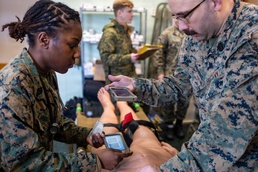
SETERMOEN, TROMSO, NORWAY– While over 25,000 troops from allied nations converge on the arctic for the Norwegian-led Cold Response 2026 (CORE26) exercise, a specialized team from the Marine Corps Warfighting Laboratory (MCWL) is focused on a very specific mission: pressure-testing the future of expeditionary medicine in one of the world's most unforgiving environments.
"CORE26 is more than a readiness exercise for us; It’s an opportunity to expand our current scope of experimentation into the arctic," said U.S. Marine Corps Lt. Col. David Alger, Concept Development Team One lead, Experiment Division, Marine Corps Warfighting Laboratory. "We are helping shape scenario development to observe the Fleet Marine Force conducting live-force life-saving actions in extreme austere environments."
The exercise, which includes forces from over a dozen NATO and partner nations, provides a realistic backdrop for MCWL's experimentation. While large-scale combat operations unfold, MCWL's team will embed with operational units to gather critical data on a series of modernization initiatives.
A key focus for the Lab is providing forward resuscitative care, prolonged casualty care, medical command, control and multi-modal patient movement capabilities.
"The concept of a 'bolt-on' damage control resuscitation team is revolutionary, but we need to validate its effectiveness in the most demanding environment imaginable," explained U.S. Navy Cmdr. Kellye A. Donovan, branch head of Expeditionary Medicine, Marine Corps Warfighting Laboratory. "Can they maintain stability in extreme Arctic conditions? How do we sustain them logistically? How do we integrate intra-theater casualty movement requirements with the combined force? These are the questions we're here to answer."
MCWL's objectives also include informing the development of expeditionary blood systems and novel hemorrhage support technology. The lab will closely evaluate the entire Class XIII logistics chain, including cold chain for blood and blood substitutes and observe forward blood collection techniques to ensure life-saving treatment can be administered at the point of injury. One element of this is to test operational prototypes of the Fieldable Solutions for Hemorrhage with bio-Artificial Resuscitation Products (FSHARP), an initiative aimed at developing a deployable, shelf-stable, universal whole blood substitute intended to sustain injured warfighters when fresh whole blood is unavailable.
Logistics and patient movement are also under the microscope. MCWL assessors will track the entire medical logistics chain, from the "burn-rate" of critical supplies during high-tempo operations to the challenges of moving patients across vast, frozen distances. The experimentation will assess the feasibility of using organic assets for long-range casualty evacuation and test the planning and coordination required to integrate patient movement via allied transportation assets.
"Every piece of data we collect, from equipment performance in the extreme cold to the command and control structure of a multi-national MEDEVAC, directly informs the future of the force," Donovan added. "The insights and lessons learned during CORE26 will be analyzed to refine future operational concepts, doctrine, and ultimately, the equipment we put in the hands of our Marines."
As forces converge in the high north, MCWL's targeted experimentation at CORE26 represents a critical step in building a more capable, survivable, and medically prepared Marine Corps, ensuring the health of every Marine, no matter the clime or place.