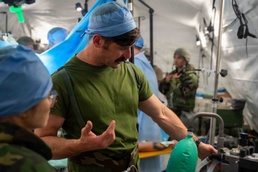
KADENA AIR BASE, Japan – U.S. Air Force Airmen assigned to the 18th Medical Group and U.S. Navy Sailors assigned to 3rd Medical Battalion, 3rd Marine Logistics Group, simulated an Expeditionary Medical Support System facility during a USAF-led exercise Beverly Midnight 26 at Kadena Air Base, Japan, March 12, 2026.
The joint training brought together Air Force, Navy and Marine Corps medical personnel to practice delivering lifesaving care in austere, deployed environments. Working in a simulated field hospital, service members rehearsed casualty treatment, emergency procedures and surgical operations designed to replicate the challenges of providing medical support during contingency operations.
“These joint exercises allow us to work alongside the Air Force, Marines and Navy and apply Tactical Combat Casualty Care in realistic scenarios in austere locations,” said U.S. Navy Lt. Alexon Munson-Catt, 3rd Medical Battalion emergency physician. “It helps turn classroom knowledge into real-world capability when every second matters.”
The training incorporated role-play scenarios and hands-on patient care, allowing medical teams to practice trauma response and surgical procedures under simulated operational conditions. To support the event, the 18th Medical Group partnered with 3rd Marine Logistics Group and U.S. Naval Hospital Okinawa, integrating surgeons, operating room teams and emergency room nurses to simulate a full-spectrum medical response capability.
“This collaboration with our sister services has been extremely beneficial for strengthening our team’s skills and readiness,” said U.S. Air Force Capt. Gabe Chase, 18th Medical Support Squadron deputy. “Working together in these scenarios helps ensure we can quickly establish medical capability and provide lifesaving care wherever the mission takes us.”
Exercise BM26 integrates joint and allied forces across multiple locations to test rapid response capabilities and improve the ability of U.S. forces to operate in contested environments. Medical training events like this ensure expeditionary medical teams can rapidly establish treatment facilities and deliver critical care in support of operations across the Indo-Pacific.