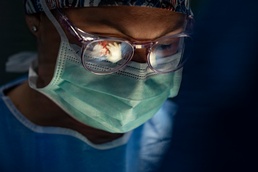
BASSETERRE, Saint Kitts and Nevis — A newborn’s first cry filled the operating room at Joseph N. France General Hospital as surgical teams from the United States and Saint Kitts and Nevis worked side by side during the Lesser Antilles Medical Assistance Team 2026 mission.
Moments like these capture the purpose of LAMAT. Medical professionals collaborating across borders to deliver care, exchange knowledge and strengthen the readiness needed for the future.
Among the team inside the operating room was U.S. Air Force Reserve Lt. Col. Emily De León, a fellowship-trained surgical physician assistant and co-mission director for LAMAT 2026. One of only a small number of surgical physician assistants serving in the U.S. Air Force, De León assisted surgeons throughout the mission while also helping lead the U.S. medical team operating across the Federation.
“I became a physician assistant to do work like this,” De León said. “To come here, work beside another medical team and help people together. Having the opportunity to step back into the operating room for this mission has been incredibly meaningful.”
LAMAT 2026 brought together U.S. military medical professionals and host-nation healthcare providers to collaborate inside hospitals and clinics across the federation. While teams delivered patient care during the two-week engagement, they also maintained the clinical skills military medical professionals must sustain to remain ready for operations around the world.
For De León, the opportunity to spend time in the operating room was essential to maintaining those skills.
“Back home I only get limited time in the operating room,” she said. “Being here allows me to stay sharp and practice the skills we may need anywhere in the world.”
Many of the procedures performed during the mission differed from what she typically sees in the United States, where many surgeries are now performed using laparoscopic or robotic techniques.
“Most of what we do at home is laparoscopic or robotic surgery,” de León said. “Here we did more open procedures, which meant I was able to assist in surgeries I had never experienced before, including my first C-section. Being part of bringing a new life into the world alongside this team was incredible.”
The experience also highlighted the resourcefulness of the Kittitian surgical staff.
“One of the most humbling things was learning how they adapt with the resources they have,” she said. “Even scrubbing in is different. It reminds you that great medicine is not about having everything. It is about the people and the commitment behind it.”
The knowledge exchange extended beyond procedures. During the mission, de León also helped explain the role of physician assistants to local providers, a profession that does not currently exist within the Federation’s healthcare system.
“They didn’t have physician assistants here, so part of our exchange was explaining what I do and how I fit into a surgical team,” she said. “Those conversations were just as meaningful as the surgeries.”
U.S. Air Force Reserve Lt. Col. Barry Davis, mission commander for LAMAT 2026 and a general surgeon with the U.S. Air Force Reserve, said De León’s impact in the operating room was clear early in the mission.
“This mission gave me the opportunity to see her operate in a surgical environment up close,” Davis said. “She stepped into every case with professionalism and technical skill. When someone demonstrates that level of capability, you give them more responsibility.”
Davis said providing those opportunities is an important part of strengthening readiness across the force.
“I pushed her into additional operative opportunities because she earned that trust,” Davis said. “That is how we strengthen readiness. You give talented medical professionals the chance to perform and grow.”
Outside the operating room, DeLeón balanced her clinical role with the responsibilities of serving as co-mission director, helping oversee personnel and operations across multiple medical sites.
“Some days I would finish a case and go straight back into mission leadership,” she said. “It was a lot to balance, but it was worth it to see our team succeed.”
For De León, one of the most rewarding aspects of the mission was watching the team grow.
“Some of our Airmen had never even been out of the country before,” she said. “Watching their confidence grow over the mission and seeing them build relationships with the doctors and nurses here was incredibly rewarding.”
By the end of the mission, those relationships were visible throughout the hospital as U.S. and the Federation medical professionals worked seamlessly together.
For De León, the true impact of LAMAT extends far beyond the procedures performed during the medical engagement.
“You can treat one patient,” she said. “But if you share knowledge with someone who will go on to treat hundreds more, the impact grows far beyond the two weeks we spend here.”