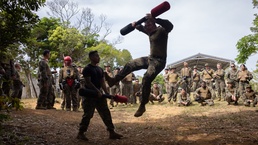
CAMP FOSTER, OKINAWA, Japan -- Recruit Tyler Thomas stepped onto the yellow footprints at Marine Corps Recruit Depot Parris Island with sweat already running down his spine. The air was thick. Thomas locked his eyes forward and straightened his shoulders. He had graduated near the bottom of his high school class, and school had never been a place where he stood out. Here, none of that mattered. The only thing that mattered was whether he could endure.
“That was the first time I felt like someone was giving me a contract,” Thomas said. “It wasn’t about where I came from anymore. It was about what I was willing to give.”
Twelve weeks later, he earned the Eagle, Globe, and Anchor. Exhausted and shaking, he understood what the drill instructors had been building from the first night. However, he did not feel finished, Thomas felt a weight of responsibility.
After completing follow-on training at the School of Infantry, Lance Cpl. Thomas reported to Kings Bay, Georgia, expecting the Marine Corps he had trained for. Instead, he stood long watches guarding strategic assets. Night after night, he wondered if this was what he had signed up for. U.S. Marine Corps Sgt. Jesse Hannah, his noncommissioned officer, noticed the doubt and refused to let it take root.
“You don’t get to decide which parts of the job matter,” Hannah told him. “If you’re trusted with something, then it matters.”
Hannah led from the front. He inspected posts personally, corrected mistakes immediately, and treated every shift as if it were a mission with real consequences. When Thomas cut corners, Hannah did not raise his voice. He made him redo the work until it met the standard. When Thomas performed well, Hannah acknowledged it without ceremony and moved on. Over time, Thomas realized Hannah was teaching him more than guard duty; He was teaching him that leadership meant setting the example when no one was watching and holding Marines to the same standard he held himself.
Thomas carried those lessons with him to Advanced Infantry Course. The training stripped away what comfort remained. Rain soaked his gear. Sleep came in fragments. Instructors pressed the students harder when they failed. Thomas lay in his fighting position one night, staring into the dark, cold and miserable. He listened to the breathing of the Marine beside him.
“When everyone is miserable together, you stop thinking about yourself,” he said. “You start thinking about the Marine next to you.”
The course reinforced what Hannah had already shown him: leadership did not begin with authority - It began with endurance and accountability. Sgt. Thomas learned that lesson again in Iraq.
An insurgent blocked a convoy of food trucks outside the base. The problem stood in the road like a wall. Supplies were already low. Marines waited inside the wire. Thomas placed his Marines in defensive positions, not to threaten, but to protect them. He scanned their faces and saw more than rifles and gear: he saw families.
“I wasn’t scared of [the insurgents],” Thomas said. “I was scared of messing up and getting one of my guys hurt.” To add to the complexity, he did not speak Arabic. Luckily, he had an entrusted interpreter available.
“I wasn’t talking to them directly,” he said. “I had to think about every word before I spoke.”
Thomas explained that he needed to be very deliberate in what he had to say so that his message doesn’t get lost in translation or misinterpreted.
The insurgent refused to move. The convoy sat still as time dragged on; Thomas held his ground.
“Those aren’t just Marines,” he said. “They’re somebody’s sons, husbands, and fathers. I wasn’t going to rush it.”
The insurgent eventually stepped aside and the trucks rolled forward. That night, the Marines ate. Thomas did not celebrate the food. He remembered the decision. Leadership meant carrying the weight so others did not have to.
Years later, loss pushed him toward a new path. Capt. Jason Back had been one of the officers who most shaped Thomas’ view of leadership. Back was calm, deliberate, and demanding without being distant. He took time to explain decisions and expected Thomas to think beyond the task at hand. More than once, Back challenged him to consider what kind of leader he wanted to be rather than what rank he wanted to wear. Thomas remembered Back as someone who never lowered standards, but never stopped believing in his Marines. Back’s influence on Thomas extended beyond professional mentorship.
“After learning of Captain Back’s death, I called his mother to thank her for the leader he was to me. She later sent me his captain’s bars and told me she wanted me to earn them. When I failed the exam, those bars reminded me why I couldn’t quit,” Thomas said.
The gesture became a personal symbol of responsibility and perseverance. Thomas kept the bars with him while studying for the officer entrance exam, viewing them as a reminder of the standard Back set and the leadership he hoped to emulate.
“If he believed in me that much, then I owed it to him to become the kind of officer he was,” Thomas said.
The Armed Services Vocational Aptitude Battery did not reward that promise at first. Thomas failed to meet the officer score three times. Each failure closed the door again. In Kuwait, during the COVID lockdown, he studied on a cot. He kept Back’s captain bars beside him as a reminder of the standard he was trying to reach.
“Failing three times messes with your head,” he said. “That fourth time wasn’t about me - It was about keeping a promise.”
He passed on the fourth attempt.
Second Lt. Thomas walked into the Communication Strategy and Operations shop with years of infantry experience and no production background. He did not pretend otherwise. He asked questions. He listened. He worked.
“He’s not the kind of officer who hides in an office,” Lance Cpl. Justin Cledera said. “If we’re working late, he’s right there with us.”
Thomas carried the field with him. He planned a live-fire training event for COMMSTRAT Marines, handled logistics, secured ranges, and led Marines through dirt and sweat.
The training tied his past to his present. Infantry had taught him discipline. Failure had taught him humility. Mentorship had taught him purpose.
“I just want them to say I cared,” Thomas said. “About the Marines. About the mission. About doing it right.”
His story did not end with a rank. It culminated in a belief: leadership does not belong to one MOS. It belongs to those who carry their failures, their mentors, and their Marines with them.
-30-