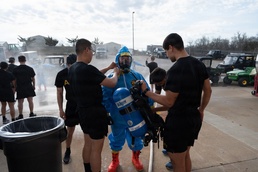
FORT LEONARD WOOD, Mo. — Homeland defense first responders specializing in hazardous material incidents receive cutting edge training through the 1st Lt. Joseph Terry First Responder Training Facility at Fort Leonard Wood. The facility, part of the Maneuver Support Center of Excellence Homeland Defense Civil Support Office’s Incident Response Training Department, is designed to provide real-world training for U.S. Army Chemical, Biological, Radiological, and Nuclear Response Enterprise Soldiers, along with joint service members and civilians in related fields. “We are the single-handed proponent for providing HAZMAT and HAZMAT technician training across the force,” said Eric Fikes, Incident Response Training Department supervisory training specialist. “In terms of our capabilities, we can essentially paint any (HAZMAT) scenario in the world.” According to Fikes, what gives the facility the ability to offer such a wide variety of training using hands-on, real-world scenarios, are the many locations featuring different environments and simulators. “We can go subterranean with our cave complex, and we can train in confined spaces,” Fikes said. “We have simulators that mimic a train derailment, bus accident scenario, overturned 18-wheeler or various chemical, biological and radiological laboratory set-ups.” Pfc. Malik Carruthers, a Soldier with the 401st Military Police Battalion at Fort Hood, Texas, is enrolled in the CBRN Response Enterprise Basic Course. He said he found the simulators useful. “It was amazing getting to take what we learned in the classroom and getting to apply that to the hands-on training,” Carruthers said. “We learned how to identify certain tankers, what hazardous materials they contain and how to properly put on the equipment to protect ourselves from harsh chemicals.” Fikes said during the CRE Basic Course, students learn how to recognize symbols, called placards, that identify the presence of hazardous material and identify what that material is. “After day one, the students can say, ‘hey, now I know what these placards mean, I know the danger associated with those particular hazards,’ and by the end of the course they will know how to defend and use available resources to keep people, property and equipment safe,” he said. The CRE Basic Course is nationally accredited, and graduates can take that accreditation with them when they go back to their units. “When students graduate, they can reach out to our compliance department and get their International Fire Services Accreditation Congress and Pro Board certificate,” Fikes said. “They can get that signed, stamped, nationally recognized certificate.” Carruthers said he thought the IFSAC and Pro Board certificate will help him as he furthers his career. “If I choose to stay in the military, I can use this information to help better myself and my Soldiers, or if I choose to go into the civilian side there’s multiple jobs that just opened up to me,” Carruthers said. “Now I have this vast knowledge and a certificate that says, ‘I’ve been here and I know what I’m talking about.’” The facility also hosts the CRE Advanced Course, Mass Casualty Decontamination Course, Civil Support Skills Course, Analytical Laboratory Course, Unified Command Suite and Air Force Emergency Management training. “The CRE Advanced Course’s target audience is a little more experienced in terms of hazardous material operations,” Fikes said. “It’s attended mostly by 74D Chemical, Biological, Radiological and Nuclear Specialists.” During the two-month-long Civil Support Skills Course, the team is “fine tuning the skills our National Guard responders need to go downrange and be safe and effective,” he said. “The objective is to keep people safe. We are essentially saving lives.” Another advantage to the courses, Fikes added, is the collective knowledge and skills students can share with their units. “Knowledge gets forced multiplied as more responders get put through the ringer and take that knowledge back to their home units,” he said. “It increases our ability to respond nationally to a domestic incident.” And that is exactly what Carruthers intends to do after he graduates from the basic course. “We are going to start implementing this knowledge by making it part of the unit’s training,” Carruthers said. “If we’re in a situation where we need to be called on to be first responders or help on the scene, we will know how to decontaminate properly, put on the proper personal protective equipment and get established.” A complete list of HDSCO courses offered at Fort Leonard Wood may be viewed in their course catalog.