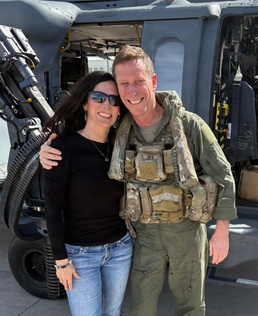
DAVIS-MONTHAN AIR FORCE BASE, Ariz. – After 36 years of service, U.S. Air Force Reserve Lt. Col. Paul Anderson, assigned to the 305th Rescue Squadron at Davis-Monthan Air Force Base, Arizona, is concluding his Air Force career with more than 6,000 flight hours in a helicopter cockpit.
Anderson accumulated hours flying the HH-60G Pave Hawk and the HH-60W Jolly Green II, reaching 1,000 hours more than the second-longest flying pilot across active duty, Guard and Reserve components.
Before Anderson would ever step into a cockpit, his Air Force career began in 1990 as a maintenance officer in Indiana and Alaska. A few years into his career, he was selected to attend pilot training, where a spur-of-the-moment decision would ultimately define the next three decades of his life.
"The flight commander came up and offered a helicopter slot," Anderson said. "I thought about it for a couple seconds and said, 'I'll take it.'"
A few weeks later, he was on his way to Fort Rucker, Alabama, for helicopter training. After graduating in 1995, Anderson’s career took him from Kadena Air Base, Japan, to Nellis Air Force Base, Nevada, before he transitioned to the Air Force Reserve and joined the 305th Rescue Squadron in Tucson, Arizona, in 2002.
While the primary mission of an HH-60 pilot is combat search and rescue (CSAR), to recover personnel from hostile or denied territory, Anderson's career reflects the aircraft’s unique capability and mission's evolution. He has deployed to Afghanistan approximately six times, where the mission was often medical evacuation for injured Army and Marine personnel.
The 305th RQS has a history of significant rescues, from hurricane relief efforts to combat operations in Iraq and Afghanistan.
In 2013, Anderson was part of a crew that rescued an injured off-duty soldier from a two-foot ledge on a mountain cliff in the middle of the night, a mission that required dumping fuel to have enough power to conduct the difficult hoist operation.
Although he performed numerous stateside operations, Anderson’s most significant was the response to Hurricane Katrina. He and his crew were among the hundreds of aircraft flying over New Orleans, performing civilian rescues in what he described as "the Wild West." He estimated his team alone rescued well over 100 people during that single week.
"We were landing on rooftops and freeways and parks," Anderson said. "You would pick up a group of people, maybe a whole family, off a rooftop, and we would take them to the airport...drop them off, take off and go grab somebody else. Just go find somebody and help them."
In total, Anderson has flown and saved several hundred people throughout his career. When reflecting on the rescue motto, "That Others May Live," his thoughts turn to the faces and missions from his deployments.
"Guys get shot up pretty good,” he said. “Or, you know, IEDs...I still think about some of those guys.”
As for his own legacy, Anderson remains humble. He hopes his fellow Airmen remember him as a "good dude" who taught them something valuable. His unprecedented flight hours were never the goal; they were simply a byproduct of never saying no.
"Up until this last deployment, I've never not gone on a deployment," he said.
As he prepares to hang up his flight helmet, Anderson's legacy is not just measured in hours, but in the lives he has helped save and the pilots he has mentored.
Recently, Anderson was part of the crew that flew the squadron's first new HH-60W Jolly Green II helicopter to Davis-Monthan, symbolizing the passing of the torch from one generation of rescue aircraft to the next.
Though retiring from the Reserve, Anderson isn’t hanging up his helmet for good. He will transition to a new role as a Functional Check Flight (FCF) pilot, continuing to fly the HH-60W to ensure it is safe and ready to fly after maintenance.
"I feel extremely lucky," Anderson said. "I know I don't deserve the career that I've had because it's honestly been great. So I got to do some really, really cool things over the years... When I was that guy in college that wanted to be an Air Force pilot, I never thought it would be as great as it has been."