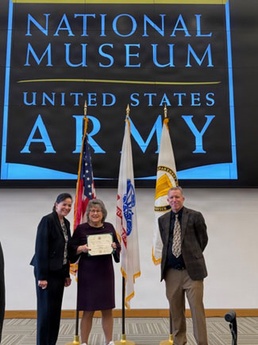
FORT BELVOIR, Va. — In a place where the Army preserves stories of valor and sacrifice, leaders gathered not simply to mark a retirement, but to recognize a lifetime of service that strengthened readiness from the home front to the enterprise level.
At the National Museum of the United States Army, Ms. Dorothy C. Smith concluded 42 years of Army Civilian service, a career that began overseas supporting military families and evolved into enterprise leadership shaping workforce development across the Army.
“This museum tells the story of our Army, a story of courage, sacrifice, resilience and service across generations,” said Karen W. Pane, director of the Army Civilian Human Resources Agency. “It honors those who wore the uniform and the Army Civilians who stood beside them in support of the mission.”
Smith’s commitment to service was instilled early. Her father, a World War II veteran, modeled duty to country, while her mother, an educator, demonstrated the value of mentorship and lifelong learning. Those influences shaped her understanding of leadership long before she entered federal service.
Before beginning her civilian career, Smith lived the life of a military spouse, navigating relocations, overseas assignments and the uncertainty that often accompanies military service.
“You live the Army mission, and frequently your personal and family life take a back seat,” Smith said. “But you also build a network and relationships that shape your growth.”
That experience defined her leadership philosophy.
“As a military spouse, you learn quickly that stability is something you create, not something you’re given,” she said. “Supporting families isn’t separate from readiness, it is readiness.”
Smith began her Army Civilian career in Pirmasens, Germany, leading Child Development Centers operating up to 65 hours per week in direct support of military families. She oversaw 100 certified Family Child Care homes across four locations and opened the first Nonappropriated Fund–constructed Child Development Center in Miesau. Every program under her leadership operated in the black.
Over the decades, she witnessed Army family needs evolve.
“Army spouses today seek meaningful careers and educational opportunities,” Smith said. “Supervisory flexibility during deployments is critical. The workforce is more educated, and technology and data skills are essential for the future.”
Following her return to the United States, Smith built Army Community Service and Child Development programs at Fort Belvoir’s Vint Hill installation, becoming the first Family Support Division chief.
Pane emphasized that Smith understood something fundamental about Army readiness.
“Readiness does not begin on the battlefield, it begins at home,” Pane said. “When families are supported and children are cared for, our warfighters can serve with focus and confidence.”
As the Army transformed, so did Smith’s responsibilities.
She served more than six years on a Military Child Care Inspection Team, traveling 26 weeks annually to 22 installations each year, ensuring compliance and program effectiveness across the enterprise. During workforce restructuring efforts, she supported senior executive service management and enterprise human resource initiatives.
At Installation Management Command and later within the U.S. Army Corps of Engineers, Smith guided more than 500 employees through academic degree training programs. She managed selection boards, developed ranking criteria and secured senior leader endorsements to advance professional development.
“I strongly believe in continuous learning,” Smith said. “Only a small percentage of employees are identified for advanced opportunities. Advanced training builds a stronger, more agile workforce.”
She also helped secure 67 U.S. Army Corps of Engineers participants into the Department of Defense SMART program and coached Senior Service College applicants, resulting in record selections.
“Dorothy has been a change maker throughout her entire career,” said Martha Bowers, director of the Installations Career Program within the Civilian Human Resources Agency’s, Army Civilian Career Management Activity. “She has consistently been the piece of the puzzle that makes the difference.”
Smith later served in Pentagon-level assignments managing career programs, expanding senior training opportunities and ensuring continuity of operations during the COVID-19 pandemic as a sole program manager. In subsequent roles within the Contracting and Equal Employment Opportunity career fields, she oversaw Fellows programs and regularly briefed senior leaders.
While advancing the development of others, Smith invested in her own growth. She earned a Master of Public Administration from American University while working full time at the Pentagon. Her thesis was awarded with distinction, an accomplishment she considers among her proudest achievements.
Reflecting on more than four decades of service, Smith defines readiness in simple terms.
“Readiness is being flexible and resilient,” she said. “You will undergo transformation during your career. Be open to change, remember the Army values and keep learning.”
Her advice to the next generation of Army Civilians reflects the perspective of someone who has witnessed decades of change.
“Everything is cyclical,” she said. “Find mentors who live the Army values. Step outside your comfort zone. If your development isn’t being supported, seek out leaders who will support it.”
For Smith, service has always meant selfless commitment.
“You are an Army Civilian 24-7,” she said. “You can make the Army a great place to work. That requires personal sacrifice, but it is worth it.”
Smith’s commitment to service has long been a shared endeavor. Her husband, retired Col. Robert John Smith, dedicated 30 years to the Army Reserve and 34 years to the Virginia judiciary, underscoring a family tradition of public service.
Pane said Smith’s career represents the enduring strength of the Army Civilian Corps.
“Dorothy’s impact lives on in the families she supported and the professionals she developed,” Pane said. “Her service strengthened readiness across this enterprise, and we are grateful for her 42 years of commitment.”
In a museum dedicated to preserving the Army’s history, Smith’s career stands as a reminder that sustained readiness is built not only in decisive moments, but through decades of steady leadership, mentorship and commitment behind the scenes.