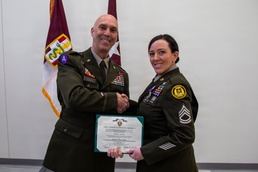
FORT SHERIDAN, Ill. — Surrounded by family, fellow Soldiers and mentors, retired U.S. Army Reserve Sgt. 1st Class Christina Larson received the Purple Heart during her retirement ceremony Feb. 20, 2026, for wounds sustained during a 2015 deployment to Afghanistan. More than a decade after being wounded in combat, the ceremony served as both long-awaited recognition of Larson’s sacrifice and the closing chapter of a military career ultimately cut short by those injuries.
The medal was presented by Brig. Gen. Todd Traver, deputy commanding general of the 807th Theater Medical Command, who served as the Commander, 3rd Multifunctional Medical Battalion (Provisional), Bagram, Afghanistan and the Deputy Commander of the Joint Task Force Medical - Afghanistan. Larson’s unit, the 911th Forward Surgical Team, fell under the 3rd during the deployment when she was injured. For Larson, having Traver present the award added deeper meaning to the moment.
“Having Brig. Gen. Traver present the award was a great honor,” Larson said. “He has been a mentor to me since my tour, offering guidance and inspiration that helped shape my career and personal growth.”
Larson began her military career on active duty before transitioning to the Army Reserve and later joining the Active Guard Reserve program. A fifth-generation service member, she said her decision to serve was driven by both family tradition and a desire to help others in moments that matter most.
During her 2015 deployment to Afghanistan, Larson served as a 68W combat medic assigned to the 911th Forward Surgical Team. As U.S. forces began drawing down operations, the small medical unit operated as a split team across two locations, requiring Soldiers to take on multiple responsibilities in a demanding environment.
“We were a small team, but we still had all the work of a normal unit,” Larson said. “That meant stepping up wherever I was needed, sometimes well beyond my job description.”
Jan. 25, 2015, became a turning point in Larson’s life and career when a vehicle-borne improvised explosive device detonated near her location.
Traver described it as an enemy attack of extraordinary magnitude, the size of which could not be overstated.
“The blast was catastrophic,” Traver said. “Not a single building on HKIA (Hamid Karzai International Airport) escaped damage. Hardened structures were shifted on their foundations. Fire doors were blown off their hinges. Windows were shattered across the base. Shrapnel from the explosion was later found on the airport runway, more than 1,000 meters from the point of detonation. After the attack, the largest identifiable piece of the truck that could be found was smaller than a basketball.”
“I was supposed to be out for a run when that truck detonated,” Larson said. “Moments before, my commander texted me to skip the run and take a ‘NATO Sunday’ (a colloquial term for a relaxed morning with no scheduled duties). As soon as I laid down, a boom sent me flying.”
“Lying on the floor, surrounded by smoke and dust, I wondered if I was alive, if I had my arms and legs, and where my tourniquet was,” she added.
Traver said Larson’s actions in the moments after the blast reflected the instinct and professionalism expected of Army medical personnel.
“In the immediate aftermath of the blast, amid confusion, alarms, and uncertainty, her first instinct was not self-preservation, it was duty,” Traver said. “She did exactly what we ask our medical Soldiers to do: she ran toward the mission.”
She gathered her equipment and weapon and moved toward the hospital to prepare for incoming casualties.
“No matter what happens, our mission is triage and casualty care, and that comes first,” Larson said.
Larson survived the explosion but sustained injuries that continue to affect her daily life. She retired with multiple service-connected conditions, including global amnesia, medication-resistant migraines and peripheral nerve damage, requiring ongoing neurological treatment and physical therapy.
“One day you can be flying high, instructing the future leaders of the formation, and the next minute you’re facing an honorable discharge because your injuries caught up with you,” Larson said.
Despite those challenges, Larson said receiving the Purple Heart represents a deeply humbling recognition of service and sacrifice.
“Receiving the Purple Heart is a profound honor, one that I accept with tremendous humility,” Larson said. “This recognition is not something I sought, but I wear it with deep respect for all who have been wounded. The Purple Heart is a reminder of the risks we take, the courage we summon, and the bond we share with those who faced adversity and kept moving forward. I carry that honor for my family, my country, and in memory of those who never made it home.”
Larson is among roughly 500 women in U.S. military history to have received the Purple Heart, with the majority of those awards occurring in combat operations following Sept. 11, 2001.
During her remarks, Larson reflected on the bonds formed through service and the resilience that comes from caring for those around you.
“I don’t feel I’ve sacrificed anything that I wasn’t willing to give up,” Larson said. “Every sacrifice felt lighter because I knew I was part of something bigger, and I wasn’t alone.”
She encouraged younger Soldiers to lead with integrity, remember the importance of people-first leadership, and reach out if you need help.
“Always put people first,” Larson said. “Soldiers are not sensitive items for squad leaders; they are our greatest asset. Also, don’t let pride, or the fear of stigma, keep you from reaching out. Get help before your injury, physical or invisible, gets the best of you. We owe it to ourselves, to our families, and to each other.”
Traver also recognized the role Larson’s family played throughout her service and recovery. “To Christina’s family: your presence here today matters,” Traver said. “You carried the weight of this service alongside her, in the long years after, and through the lasting effects of her injuries. This Purple Heart belongs not only to the Soldier who wore the uniform, but also to the family who stood behind her with strength, patience, and unwavering support.”
Larson concluded the ceremony by honoring our fallen comrades and thanking her family and fellow Soldiers who supported her throughout her career and recovery.
“My time in uniform ends today,” she said, “but my gratitude and commitment to the Army family are forever.”