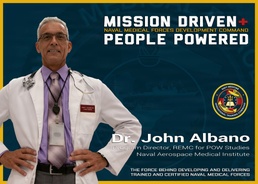
JOINT BASE SAN ANTONIO-FORT SAM HOUSTON, Texas – The Naval Medical Forces Development Command and the Navy Medicine Operational Training Command (NMOTC) are mission driven and people powered.
With almost 35 years of combined military and civilian corps service under his belt, Dr. John P. Albano has served as the program director for the Robert E. Mitchell Center (REMC) for POW Studies since 2018.
Albano answered a few questions about his career and role at REMC, a special program of NMOTC’s Naval Aerospace Medical Institute.
Q: Why did you join the military/civilian service?
A: Having retired from the Army after 26 years, 3 of which were in the Air Force Aerospace Medicine Residency Program and 7 of which were as Liaison Officer to the Navy Aerospace Medicine Residency Program, I had an innate and uncompromising strong desire to continue serving in a civilian capacity. NAMI was a perfect fit on many levels and to which my experience could best contribute.
Q: What do you enjoy most about your job/command and what keeps you motivated?
A: On a personal level, I enjoy waking up every morning, with an insatiable sense of purpose, eager to evaluate repatriated POWs, hearing their story first hand, and contributing to their interim medical and psychological wellbeing. On a programmatic level, I am motivated by the threat of the next potential great power conflict, which will produce a new cohort of younger POWs and how to translate the lessons learned from the REMC POW Program's research to that fight.
Q: How does your role support the Force Development and Force Generation of the Navy’s medical forces?
A: Integrating REMC research into NMOTC's core curricula will produce a more resilient and mission-ready medical force. By formally training our medical teams in the nuanced psychological and clinical aspects of Personnel Recovery, they can provide comprehensive care that enhances the well-being and operational readiness of every sailor. This directly translates to a more effective force, strengthening Navy Medicine's ability to support the warfighter from the point of injury to a successful return to duty.