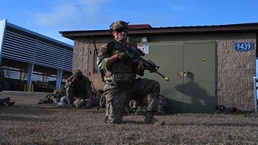
HURLBURT FIELD, Fla. -- The 31st Combat Air Base Squadron enhanced its ability to provide base operating support and sustain airpower projection during a Silver Flag training exercise at Tyndall Air Force Base, Feb. 8-13, 2026.
Silver Flag was part of the second 200-level field training exercise in 31 CABS’ road to deployment with the 31st Air Task Force. During the week-long event hosted by the 801st Rapid Engineer Deployable Heavy Operational Repair Training Squadron, over 240 Airmen from two MAJCOMs and two wings exercised force bed down, base recovery, rapid airfield damage repair, and counter-unmanned aerial systems techniques, among a host of other necessary skillsets.
“Silver Flag is designed to teach civil engineers and force support personnel wartime task standards to prepare them for downrange environments,” said Master Sgt. Douglas Dees, an instructor with the 801st RED HORSE Training Squadron. “The Silver Flag campus doesn’t reflect a specific area of responsibility but exists in bare base conditions that are relevant to any region.”
During its first field training exercise at Fort Bliss last December, every CABS member underwent the same training in core protection and sustainment. During Silver Flag, 31 CABS built on that experience, breaking into cross-functional teams formed according to specialty and training—electrical, structures, water and fuel systems, emergency management, contracting, explosive ordnance disposal, and force support among others. During the evaluated, 36-hour capstone exercise, each of these teams activated to tackle simulated missile attacks, actual airfield explosions, search and recovery operations, and an aircraft crash scenario, all while maintaining an air base under advanced threat level.
“This training is very important to the CABS because, when we deploy, we are going to be tasked with generating overwhelming combat air power,” said 31 CABS noncommissioned officer in charge of expeditionary logistics. “That is the crux of why we’re here and what we’re doing.”
The Silver Flag Exercise Site also provided space for specialty training apart from the exercise curriculum. Medics assigned to 31 CABS conducted trauma response and mass casualty training in an air transportable clinic. This specialized expeditionary instruction was a first for an Air Force unit of action still in its pre-deployment phase. Security Forces Airmen also trained with cutting-edge technology designed to detect and defend against hostile unmanned aerial systems.
After completing the Silver Flag curriculum, 31 CABS joined the 31st Air Task Force in a live virtual integration with Exercise Bamboo Eagle 26-1, Feb. 15-21. Bamboo Eagle presented participants with opportunities to overcome challenges associated with mission generation and command and control in contested environments. 31 ATF and 31 CABS exercised proactive and reactive schemes of maneuver, in virtual and actual interfaces, with the aim of increasing survivability and ensuring air superiority for the joint force.
“Together, 31 CABS and 31 ATF provide the Air Force real unity of effort and unity of command,” said 31 CABS commander Lt. Col. Joshua Pratt. “We train, we organize, and we deploy together.”
The 31st Combat Air Base Squadron is a multi-functional unit spanning 60 AFSCs and bringing together Airmen from two MAJCOMs to deliver base operating support while sustaining up to three mission generation force elements capable of executing agile combat employment at any deployed location.