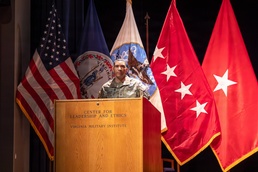
When Brig. Gen. Maurice “Moe” Barnett first began his career with the U.S. Army, he only focused on the short term. He wanted to complete his time in Army ROTC, give it a few years as an Army officer, and move on to something different.
"I thought I wanted to be a dentist or a doctor, so I was a non-scholarship cadet,” Barnett said. “I had a three-year obligation on active duty, and I thought I was going to get out.”
Now in his thirty-first year with the Army and as the outgoing Commanding General of U.S. Army Cadet Command, fate has continuously focused Barnett on his true calling for servant leadership.
“My purpose in life is to help people reach their full potential – the Army gives me that opportunity,” he said.
“I’ve had some people who have advocated for me, who saw something in me and said, ‘I want you on my team’ or ‘You need this opportunity,’ and it’s my good fortune that those people have seen that in me, even when I couldn’t have envisioned something like this for myself.”
***
As a high schooler in Gary, Indiana, Barnett participated in the Junior Reserve Officers’ Training Corps and was encouraged by his instructor to give the Army a try. He next found himself in the Reserve Officers’ Training Corps at Indiana University, graduating in 1994 and commissioning as a second lieutenant in the Air Defense Artillery Corps – a true product of the very command he has been leading for the past year and a half.
And, while he’d originally planned on a different career path outside of the Army, Barnett constantly finds himself reaching “full circle moments” – like serving as the Deputy Commanding Officer for U.S. Army Cadet Command from 2021 to 2022 and then assuming the role of commanding general in 2024.
“I was excited to come back because of the people and the mission,” Barnett said. “Working with cadets in both Junior ROTC and Senior ROTC, it’s just an incredible mission that the command does.”
“What we do for high school students who are participating in Junior ROTC is life changing, and its motivating to be around them and to see their inspiration. And then, on the Senior ROTC side, we get to see the development of college cadets into second lieutenants for our Army.”
Barnett assumed command at a complex moment in Cadet Command’s history. Confronted with policy changes and expectations to compound the command’s mission while aligning with changes across the total military, he was tasked with the challenge of simultaneously growing and reducing different aspects of a command with a national presence of over 300,000 high school and college cadets, cadre, and staff.
“On the JROTC side we’re growing exponentially – just this year we’ve added about ten programs. We’re programmed over the next four or five years to add over 50 programs a year…it won’t be long before we have 2,000 JROTC programs across the country and that’s a change and a significant growth,” Barnett said.
“On the Senior ROTC side, that’s where we’ve tried to consolidate some things based on resource changes. We didn’t close any programs, but we reoptimized our command footprint, and that is the most significant change on the Senior ROTC side than we’ve had for more than 30 years.”
As part of the Army’s broader need to reduce the civilian workforce, Cadet Command rebalanced and optimized its Army ROTC programs. Barnett was able to avoid closing programs after a collaborative effort across the command to consolidate people and resources.
For Barnett, it was also about steering Cadet Command toward a franchise mindset and focusing on uniformity in programs and standards where "every cadet could have the same or similar Army ROTC experience."
“If you’ve seen one ROTC program you’ve only seen one ROTC program, and we have a lot more than one ROTC program,” Barnett said.
“Our mission is the same at every one of those colleges and universities regardless of their resources and their size. We still have the same obligation to produce a second lieutenant who has met their requirements and is ready to lead the sons and daughters of our Nation.”
Like his predecessors before him, Barnett set out to make an impact in a command that spans all 50 states, U.S. territories and a handful of countries around the world. He traveled to numerous regional and national events while carving out time to visit dozens of Army JROTC and ROTC programs across the country.
“In a normal command you can go and see everybody, every day. Here, you can’t do that,” Barnett said. “That’s part of the goodness and also the difficult part of the command, we’re everywhere…”
“It’s also great because from the SROTC and JROTC perspective we’re going to have second lieutenants and high school cadets from every zip code in the country. I think that’s important and really speaks to the reach and impact that the command has.”
Getting out and involved across the command, Barnett was able to witness the impact of Army ROTC and JROTC’s mission on its students.
It’s one of the factors Barnett will miss most as he transitions over to the United States Space Command later this month to assume the role of J5, Director of Plans and Policy.
“Changing a high school students’ life by giving them a four-year scholarship and seeing, not only their enthusiasm, but their parent’s enthusiasm, I’ll miss that,” he said. “I’ll miss seeing an Army ROTC cadet pin on a gold bar and get the opportunity to go and lead America’s sons and daughters.”
In the 19 months Barnett led Cadet Command, over 6,500 second lieutenants were commissioned into the U.S. Army and roughly 9,000 cadets completed Cadet Summer Training in preparation to contract or commission.
“We’re changing lives and that’s what this command represents. It represents the future of leadership, not just for our Army, but for our Nation,” Barnett said. “Think about the impact we get to have, producing people of caliber who will lead companies, create things, save lives, change the world – and that’s what we get to be part of.”
“We get to be part of their legacy just by being Army ROTC.”