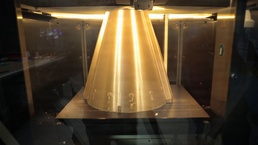
Corpus Christi Army Depot, Texas--The UH-60 Black Hawk can be configured with different fuel tank configurations depending on mission requirements, such as combat missions. In some cases, the fuel tanks can hold an extra 250 gallons of fuel, extending the aircraft's flight time. CCAD has pioneered the use of 3D printing to manufacture replacement tail fins for the UH-60 Black Hawk's Crashworthy External Fuel System. The tail fin frequently becomes damaged during loading, removal, or landing. If damaged, the part is deemed destroyed, and the aircraft is inoperable.
Composites are the future in Army Aviation, and CCAD has approximately 30 composite artisans. The shift toward these materials is significant; the Future Vertical Lift structural parts are up 50+ percent toward composite design. Composite Fabricator Supervisor Daniel Izcano: “When people think of composites, they think in terms of carbon fiber and Kevlar. They do not see a [part] component.”
During a workforce update, Maj. Gen. Lori L. Robinson, commanding general of the U.S. Army Aviation and Missile Command, stated, “For decades, our maintenance expertise has centered on metallic sheet metal airframes. However, the prevalence of composites demands a parallel and equally robust sustainment framework.” In October 2025, the engineering branch initiated a project using 3D printing to produce a tail fin for a UH-60’s external fuel system. Following a comprehensive structural analysis and technical evaluation, leadership at Redstone Arsenal determined that the depot possessed the capability to manufacture a viable replacement. This problem was caused by a shortage of components from the original equipment manufacturer.
Justin Cook, branch chief for the Manufacturing Engineering Branch, noted that, despite challenges during a furlough, the department prioritized procurement and technical readiness. “We didn't have the files and were experiencing the furlough,” Cook stated. “But we moved forward with ordering supplies and performing software upgrades.”
Fostering a culture of excellence and trust, the depot ensures fleet readiness by developing 3D-printable components to proactively mitigate future supply chain shortages.
Izcano said, "By showcasing our processes, we want Army Aviation to know that CCAD brings solutions."
To ensure airworthiness, the depot must maintain a production certificate or explicit approval from the Federal Aviation Administration. This certification shows that the Corpus Christi Army Depot has a strict quality management system in place to find and fix problems before a part is installed and ready for flight.
Maj. Gen. Robinson stated, “Our soldiers, schoolhouses, and depots must be prepared to repair advanced composite parts and structures to keep our fleets at the highest rates of readiness and availability on the battlefield.”
The situation called for strategic resourcefulness. Cook generated test files using available materials to demonstrate the expected output of the final print. The resulting prototype was manufactured using polycarbonate, a high-performance engineering thermoplastic. Unlike the most common commodity plastic, polycarbonate is utilized in aerospace for its transparency, impact resistance, and thermal stability.
The procurement phase for the polyetherimide thermoplastic blend and associated software took approximately two months. To ensure structural integrity, data from the National Center for Advanced Materials Performance was used. These data sets establish fixed printing parameters like temperature and speed to ensure the part printed today has the exact same strength as the part tested years ago.
After the polyetherimide thermoplastic sheets were received, the fin was printed in four distinct segments and assembled over a total of 82 hours. An additional 16 hours were required for each segment to undergo a rigorous inspection to verify dimensional accuracy and adherence to the Certificate of Conformity. This adherence is part of the mandatory traceability process, which ensures that materials are tracked to their original source to certify flight readiness and safety.
Furthermore, the composite material must comply with Federal Aviation Regulation standards for flame, smoke, and toxicity. This ensures that if a fire occurs, the part will not spread flames or release poisonous gas.
The total labor for the tail fin assembly, from start to finish, was approximately 60 hours. Following the initial assembly, the next step was the tooling phase, which involved drilling and countersinking the component. Once machined, the parts were transferred to the composite shop for structural adhesive bonding and the riveting of portables. The final stage of the production is the application of paint to the component.
Christopher McKenzie, an equipment specialist within the Manufacturing Engineering Branch, outlined the department's role in translating digital designs into physical components. He said, "Our function is to create computer-aided design plans for our structures and sheet metal parts for the aircraft."
Regarding the tail fin specifically, McKenzie said that the component is "critical for the possibilities to support our warfighters with our capabilities."
In additive manufacturing, tooling refers to the engineered molds used to shape adhesive films, resins, or specialized fibers into a finished product. There are various iterations; the dry layup involves placing dry sheets into the mold, and the resin is introduced later through a vacuum infusion process. Then there is metal bonding, which is the structural adhesive bonding of metal parts instead of using traditional fasteners like rivets, bolts, or welding. Which prevents fatigue from cracking and allows for thinner, lighter metal sheets to be used. Finally, there is the dry lettering, which is the marking and identification during the tooling process.
"An important process in finalizing a component is tooling," said Byron Driscoll, the Production Engineering Branch Manager. "This process reduces manufacturing mistakes and decreases labor hours."
According to Maj. Gen. Robinson, “It is about building a resilient, adaptable, and affordable maintenance system that can support the Army aviation enterprise for decades to come.”
CCAD is transforming its technology development to keep up with the evolving battlefield.