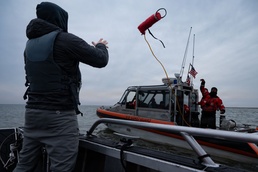
JOINT BASE MCGUIRE-DIX-LAKEHURST, N.J. -- The 305th Operations Support Squadron’s Survival, Evasion, Resistance and Escapeshop led a water survival readiness training, partnering with 305th OSS aircrew flight equipment, 108th OSS SERE, 87th Medical Group and U.S. Coast Guard Station Atlantic City to execute Exercise Neptune’s Gauntlet at USCG Station Atlantic City, N.J., Feb. 17-19, 2026.
The exercise allowed SERE specialists and AFE Airmen to maintain their unit’s mission preparedness and monitor water survival equipment supplied to C-17 Globemaster III aircrew.
AFE Airmen are responsible for ensuring all safety and flight equipment is in perfect condition before packing supplies onto an aircraft. SERE specialists equip aircrew and high-risk-of-isolation personnel with knowledge on how to survive different life-or-death situations. Together, they sustain mission-ready aircrew by ensuring they are equipped with water survival knowledge and supplies.
“It is important for AFE Airmen to partner with SERE specialists because together we complete the survival mission,”said U.S. Air Force Master Sgt. Juan Arrieta, 305th OSS aircrew flight equipment flight chief. “AFE ensures the equipment is dependable and SERE ensures Aircrew members know how to use it effectively under stress. Training side‑by‑side allows both career fields to identify equipment strengths, limitations and opportunities for improvement. That collaboration enhances training quality, informs future equipment upgrades and ultimately increases aircrew survivability.”
Four AFE Airmen and three SERE specialists loaded into the 46-man life raftand assembled a canopy for protection from the elements, removed excess water inside the raft, distributed food and water rations and monitored Viking anti-exposure suits, accessory kit and life raft.
Senior Airman Keith Apostolos, 305th OSS SERE specialist and Exercise Neptune’s Gauntlet operations lead, emphasized the importance of partnering with other units during the exercise due to needing so many learning objectives completed.
“SERE and AFE work hand in hand quite a bit,” said Apostolos. “Often, [305th OSS AFE] load the jet with gear, but they don’t get to use it or see how it’s used. This was a great opportunity for them to get that training.”
While the exercise focused on interagency operability and monitoring survival equipment and procedures, Apostolos also emphasized the importance of having the will to survive in these situations. He explained that it is easy to become apathetic and lose motivation during survival conditions, but a successful return depends on the will to survive.
Airmen applied that mindset during their time in the life raft.
“Since completing water survival training, I gained a deeper understanding of my mental and physical resilience under stress,” said Airman 1st Class Zane Gutierrez, 305th OSS AFE technician. “Operating in a life raft while enduring cold exposure, dehydration, hunger and sleep deprivation reinforced the importance of maintaining composure and a positive mindset in adverse conditions. I learned that while every individual may be experiencing the same discomfort, projecting confidence and mental strength is critical to sustaining team morale and overall survivability.”
Gutierrez highlighted the importance of working with the SERE specialists because their knowledge bridged the gap between equipment management and practical application, which ensured that they not only understood the functionality of the gear but how to maximize its effectiveness.
As Airmen monitored equipment in the life raft, Coast Guardsmen assigned to USCG Station Atlantic City rehearsed man overboard recoveries and towing procedures in the surrounding waters—coordinating with additional SERE specialists in a simulated recovery operation that mirrored how real-world maritime rescues would unfold. Training side-by-side strengthened interagency communication and reinforced the teamwork required to recover isolated personnel.
“Working with the Coast Guard makes me a better SERE specialist because I’m able to talk with them and learn their capabilities,” said Apostolos. “Constantly working together with other agencies helps us to learn their capabilities so when we’re in a time of need, we’re able to call upon the right people.”
The exercise highlightedmission readiness and how the cooperation of each mission partner is equally critical to maintaining aircrew survivability and sustaining the 305th Air Mobility Wing’s global support.
“Readiness exercises like this are important because they test our Airmen, our equipment and our procedures under conditions that closely mirror an actual emergency,” said Arrieta. “They provide data driven insight into how well our systems perform when lives depend on them. These scenarios sharpen decision making, expose areas for improvement and ensure our force remains fully prepared to respond in any environment.”
Arietta said the exercise achieved its goal of providing performance feedback and strengthening future equipment and procedures through collaboration between the various units. This ultimately demonstrates that readiness is not just a slogan, but a commitment to preparation, partnership and performance under pressure.