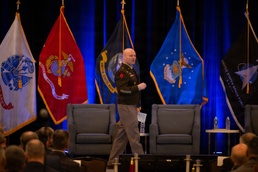
WASHINGTON — The Joint Interagency Task Force 401 (JIATF 401) hosted an Industry Day, bringing together representatives from industry and government partners to discuss collaboration and accelerate the development of counter-small Unmanned Aerial Systems (c-sUAS) capabilities at the Hilton Alexandria Mark Center, Alexandria, Va., on March 5, 2026.
The event provided a forum for JIATF 401 leadership to outline the organization’s mission, priorities and acquisition approaches while allowing industry partners to engage directly with government stakeholders on emerging technology and operational needs.
“I want you to know what we’re doing to make your products accessible to our customers and what we’re doing to expand that customer base so we can get greater depth in our industrial base,” said U.S. Army Brig. Gen. Matt Ross, Director, JIATF 401.
Ross highlighted how the accessibility and low cost of small unmanned systems have changed the security environment. Systems that were once limited are now widely available, allowing smaller groups or individuals to operate capabilities which previously required significant resources.
“What they’re concerned about is the proliferation of small unmanned systems that are inexpensive and give capability that was previously reserved for state adversaries to small groups and individuals,” Ross continued. “It’s not a new thing, but if you give them the ability to conduct some type of attack without fear of attribution or accountability, that changes the paradigm.”
He emphasized that industry feedback is necessary to address gaps in current systems and improve how c-sUAS technologies are integrated across the Department of War and interagency partners. He noted that companies frequently ask what standards or protocols their systems must meet to integrate with existing c-sUAS ecosystems.
“One of the things we want to do is change the way the department is thinking about counter-sUAS,” Ross said. “One of the ways we can incorrectly think about the problem is in how we manage risk or how we accomplish the mission. Instead of defeating the threat of a system, we have to think about the broader problem.”
This shift in thinking requires focusing on operational outcomes, rather than simply targeting individual systems and countering-small unmanned aircraft. It requires understanding how those platforms are used and how they enable broader mission effects. The growing complexity of the threat environment means there is no single system capable of addressing every scenario. Instead, organizations must rely on a layered approach that combines different capabilities to detect, track and defeat unmanned systems.
“I’m not asking for a 100 percent solution to defeat every drone - the silver bullet,” Ross concluded. “What we need is a layered defense: awareness, different capabilities and an ecosystem that works together so we can defeat threats consistently.”
Ross mentioned that continued collaboration between government and industry will be essential to developing those layered defenses and ensuring effective integration of c-sUAS technologies, supporting our warfighters at home and abroad.