During Operation Desert Shield/Operation Desert Storm 35 years ago between August 1990 and March 1991, nine Wisconsin National Guard units deployed to support the operations to respond to Iraq invading Kuwait. The 107th Maintenance Company was among those nine Wisconsin National Guard units.
The 107th Maintenance Company is a maintenance unit historically headquartered in Sparta, Wis., with detachments in places such as Viroqua and Sussex. Its mission, according to the Wisconsin National Guard, has primarily been maintenance, repair, and recovery of Army equipment, ensuring vehicles, weapons, and support systems remain operational during training and deployments.
According to history, Operation Desert Storm (Jan. 17 – Feb. 28, 1991,) was a U.S.-led coalition military campaign to liberate Kuwait after Iraq’s August 1990 invasion. Following months of buildup (Desert Shield), a five-week air campaign crippled Iraqi defenses, followed by a decisive 100-hour ground assault that expelled Iraqi forces.
On call for deployment
The 107th Maintenance Company went on alert for deployment to Operation Desert Shield on Aug. 4, 1990, according to former unit member Duane Streeck, who also later deployed with the unit.
Between mid-September and mid-November 1990, the unit mobilized and deployed from Fort McCoy to the Port of Dammam, Saudi Arabia, where they worked at the port until their return to Wisconsin in spring 1991.
The unit had about 215 personnel when mobilized, history shows. Their mission in Southwest Asia was unique. Maintenance units like the 107th were responsible for keeping coalition equipment operational in harsh desert conditions.
Typical duties included:
— Repairing combat and support vehicles.
— Maintaining weapons and communications equipment.
— Recovering disabled vehicles from training or combat operations.
— Preventive maintenance to protect equipment from sand and extreme heat. This work was critical because coalition forces relied heavily on mechanized and armored equipment during the campaign.
During the ground war, maintenance units supported the massive coalition ground force that launched the 100-hour ground campaign in February 1991. Although maintenance units typically were not frontline combat units, their work ensured tanks, trucks, and artillery could operate continuously during the offensive.
Looking back at their McCoy training
Fort McCoy served as a major mobilization and training center for Reserve and National Guard units during the Gulf War. Between August 1990 and March 1991, 74 units from nine states processed through Fort McCoy. Plus, more than 18,000 service members and 3,000 pieces of equipment deployed from the installation. And, this was the first large mobilization at Fort McCoy since the Korean War.
Streeck also indicated that the 107th was probably the most local unit to Fort McCoy, including the fact that many 107th members were either employed at McCoy as civilians regularly, or they lived nearby.
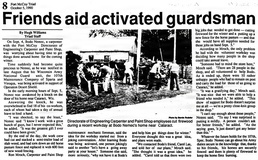
That local connection was reflected in an article in the Oct. 5, 1990, edition of The Triad newspaper at Fort McCoy entitled, “Friends aid activated Guardsman.” The article, written by Triad staff member Hugh Williams, saw a group of people come together to help a member of the 107th.
“On Sept. 4, (1990), Bodo Nemec, a carpenter with the Fort McCoy Directorate of Engineering’s Carpenter and Paint Shop, was worrying about having time to get things done around home for the coming winter.
“Time suddenly had become quite precious to Nemec, as he was notified in late August that his Wisconsin Army National Guard unit, the 107th Maintenance Company of Sparta and Viroqua, was being activated in support of Operation Desert Shield,” the article states. “In the early morning hours of Sept. 5, Nemec was awakened by a knock on the door of his home near Cataract, Wis. Answering the knock, he was overwhelmed to find 18 of his co-workers, each of whom had taken a day of annual leave to lend a hand.”
“‘I was shocked, to say the least,’ Nemec said. ‘I know I work with a great bunch of guys, but I never expected this. It was the greatest gift I ever could have been given.’”
By the end of the day, the work crew had cut and stacked a semi-trailer load of slab wood, and had torn down an old horse pasture fence and replaced it with 600 feet of new wood fencing, the article states.
“Ron Mroch, Carpenter and Paint Shop maintenance mechanic foreman, said the idea for the workday started out from a joking conversation. After learning Bodo was being activated, one person jokingly said to another ‘let’s have a going-away party at your house.’
“Someone else said, more seriously, ‘why not have it at Bodo’s and help him get things done for winter.’ Everyone thought this was a great idea, and plans were made.
“‘We contacted Bodo's friend, Carol Las, and told her of our plans,’ Mroch said. ‘She thought it was a great idea. Carol told us that there were two big jobs that needed to get done — cutting firewood for the winter and a putting up a new fence for the horse pasture — and that she would have all supplies needed for those jobs on hand Sept. 5.’”
“‘It was a gratifying day,’ Mroch said.”
Getting ready to go from McCoy in ‘90
By November 1990, the 107th was finishing it’s training at Fort McCoy and was being ready to deploy to Saudi Arabia by mid-month.
In another news article by Rob Schuette in the Nov. 2, 1990, edition of The Triad newspaper entitled, “107th: Maintenance unit ready to serve,” the unit’s commander discussed what the 215 Soldiers in the unit were getting done.
“From before the time when Robert B. McCoy, Fort McCoy's namesake, was commander of its predecessor unit, the 107th Wisconsin Army National Guard Maintenance Company from Sparta and Viroqua has served the nation in time of need,” the article states.
“Capt. Patrick Rubel, the l07th’s current commander, said that after campaigns in the Mexican-American and Spanish-American Wars, World Wars I and II and the Berlin Crisis, the 107th now is processing and training at Fort McCoy in preparation for deployment to support Operation Desert Shield.
“The company is undergoing training in nuclear, biological, and chemical warfare; physical conditioning; marksmanship; map reading; and land navigation, Rubel said. The 107th has a mission of fixing almost anything from canvas and tents to electronic equipment, and tanks and Howitzers to generators.”
“‘We’re in pretty good shape,’ Rubel said. ‘We’re going to continue with our sustainment training until we're deployed.’ Members of the unit have an advantage over many of the other units training on post because they train here regularly, Rubel said.
“They know where many buildings are located and the best ways to get to the appropriate post ranges. Troops also are familiar with each other. Members of the unit include several brothers, a set of identical twins, and three father-and-son duos.
“One of the father-and-son duos is Spec. Brian Van Wormer and his father, Staff Sgt. Thomas Van Wormer, who also works at the Mobilization and Equipment Training Site on post, both from Sparta.
“‘My father is a big influence,’ Brian Van Wormer said. ‘When we’re in uniform, I’m a specialist and he’s a staff sergeant, but when we’re out of uniform we’re father and son.’
“Spec. Gary Graham from the 107th’s Unit Armor section said the entire 107th is like a big, happy family that pulls for each other.
“‘Our training here has been very realistic,’ he said. ‘We use MILES (Multiple Integrated Laser Engagement System) equipment that gives you a very good idea of combat firing under field conditions.’
“Post support has been excellent, Rubel said. Desert Shield preparation also gives them more time to do more collective unit training than annual training does.”
Doing the deployment
Streeck said conditions working at Dammam included extreme heat and humidity from the Persian Gulf.
History shows a massive staging areas full of vehicles and containers. The area had round-the-clock logistics operations, and sand and salt air were affecting mechanical equipment. Maintenance units like the 107th worked long hours to ensure equipment moved forward to the front.
Overall, at the Port of Dammam, the 107th Maintenance Company helped inspect, repair, and prepare military equipment arriving by ship, enabling U.S. Army units to move vehicles and weapons forward for the campaign that liberated Kuwait.
After the end of operations, they returned to McCoy in late spring 1991.
Learn more about the 107th Maintenance Company by visiting the Wisconsin National Guard website at https://wi.ng.mil. Learn more about the National Guard by visiting https://www.nationalguard.mil.
Fort McCoy’s motto is to be the “Total Force Training Center.” Located in the heart of the upper Midwest, Fort McCoy is the only U.S. Army installation in Wisconsin.
The installation has provided support and facilities for the field and classroom training of more than 100,000 military personnel from all services nearly every year since 1984.
Learn more about Fort McCoy online at https://home.army.mil/mccoy, on Facebook by searching “ftmccoy,” on Flickr at https://www.flickr.com/photos/fortmccoywi, and on X (formerly Twitter) by searching “usagmccoy.”
Also try downloading the My Army Post app to your smartphone and set “Fort McCoy” or another installation as your preferred base. Fort McCoy is also part of Army’s Installation Management Command where “We Are The Army’s Home.”