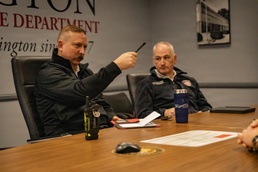
WILMINGTON, N.C. — Recently, a team of U.S. Army special operations civil affairs (ARSOF CA) soldiers, based at Fort Bragg, N.C., conducted a series of engagements with local civil agencies, gathering critical data and executing thorough assessments to benchmark their high performance and effectiveness. The team quickly translates those lessons into best methods and practices to bring forward to future deployments. These recent engagements, with both the Wilmington Fire Department and the North Carolina State Ports Authority at the Port of Wilmington, focused on observing, cataloging, and analyzing the operational capabilities, security readiness standards, and governance structures that enable both to deliver reliable civil and emergency services, maintain public safety, and support commerce for hundreds of thousands of citizens throughout the region. For Civil Affairs Teams (CATs), these visits are not ceremonial or performative, they are a critical initial step to how civil affairs accomplishes its mission globally.
Benchmarking Excellence at the Source
At the Wilmington Fire Department, the CAT met with Derek Minckler, the chief of operations and nearly 20-year veteran firefighter, to gain insight into the agency’s rigorous training, crisis response procedures, risk analysis frameworks, equipment readiness, and resource allocation models. Minckler demonstrated baseline engine company equipment loadouts, pre-call checklists, vehicle maintenance and preparation, water rescue capabilities, and the integration of specialized units to support the force. A perfect example of this was their deployment of crisis response dogs, or CRDs, in their headquarters. These dogs provide comfort and companionship to firefighters and staff, often immediately after an emergency medical or fire call. “You might have had to perform CPR that night on a struggling patient on (an emergency medical incident) and when you get back to the station, the dogs know you struggled and are there for you,” Minckler explained.
The CAT went on to inspect the city’s water rescue boat and listened closely to Minckler explaining the challenges of performing water rescue operations in the Cape Fear River, their primary area of responsibility. “The water is murky and it is nearly impossible to see, so we train by feel,” Minckler described, “it isn’t like diving in the Atlantic (ocean).” The team went on to review emergency dispatch and asset deployment methodologies, asking targeted questions about surge capacity and interagency coordination with local, state, and federal partners; data points that would later inform their reporting. These observations, and others like them, form the foundation of what the U.S. Army Special Operations Civil Affairs regiment calls “civil reconnaissance”; systematically identifying strengths and opportunities in a high-performing civil entity/agency to inform future operations both at home and abroad.
“Civil affairs doesn’t just look at what an organization has,” one team member explained during the visit. “We assess how it thinks, how it trains, how it builds and sustains readiness, and, most importantly, how it integrates those values into the broader civic ecosystem.”
By understanding how a mature, well-resourced, and high-functioning fire department mitigates risk, performs under pressure, and maintains public trust, CATs develop replicable assessment frameworks. These frameworks are later specially curated and adapted to advise, assist, and enable partner agencies, forces, and nations to improve emergency response systems, disaster relief mechanisms, and public safety governance to promote stability and build public trust.
Gateway to the American Southeast
The team then shifted its focus to the Port of Wilmington, operated by the North Carolina State Ports Authority. There, civil and military security partners – to include the U.S. Coast Guard – and commercial stakeholders briefed the team on operations, their multi-layered security measures, and the cohesive interagency coordination across multiple agencies. The team learned that the Port of Wilmington alone employs, or directly supports, more than 100,000 jobs, more than $650 million in tax revenue for the State of North Carolina, and contributes more than $16 billion in overall economic impact for the region. Furthermore, there is an emerging $500 million investment, from private and public sources, slated to upgrade current equipment, facilitate growing volume, and harden security measures. The port boasts the best cargo speeds on the east coast and rates No. 1 in the World Bank’s Container Port Performance Index (CPPI) for North America.
The Port’s chief of operations, and U.S. Merchant Marine veteran, Doug Vogt detailed operational workflows and demonstrated the intricacies of the ship-to-shore crane systems that enable efficient cargo movement and maximum delivery speeds. CAT personnel observed container handling procedures, security protocols in practice, and resilience planning designed to ensure continuity of commerce even during disruption or disaster. For CATs, ports represent more than economic nodes—they are strategic infrastructure. In competition, crisis, or conflict, the ability of a nation to facilitate commerce, receive and distribute aid, while maintaining maritime security directly impacts stability.
“Ports are economic and security lifelines,” a CAT team member noted. “They connect global to local supply chains, enable humanitarian assistance, and serve as critical points of influence in economic and civil competition. If we understand how a high-functioning port operates here, we can bring those best practices to our partners to replicate that locally.”
The assessment process includes identifying governance structures, public-private coordination models, regulatory oversight mechanisms, and crisis contingency planning. These insights allow CATs to advise commanders and partner agency/force leadership on how best to strengthen civil infrastructure to withstand impacts anywhere from natural disasters up to armed conflict.
Lessons Learned for Our Partners
The engagements in Wilmington, N.C. illustrate a critical example of the broader civil affairs mission within U.S. Army special operations. While conventional forces focus on defeating the enemy and seizing key terrain for military objectives, civil affairs units concentrate on strengthening institutions, services, and enabling populations to more effective governance; ultimately determining long-term legitimacy and civil stability.
Benchmarking agencies like the Wilmington Fire Department and the Port of Wilmington, CATs ultimately refine their ability to conduct these kinds of structured civil affairs assessments with U.S. partners and allies, as well as to bring them invaluable insights. In global competition, where influence often outweighs raw military force or intimidation, building and maintaining strong civil institutions are strategic assets where U.S. policy determines the strategic interest. In crisis, they are lifelines. In conflict, they become the foundation for stabilization and a swift recovery. The methodology remains consistent: observe, engage, analyze, and translate lessons into partner capacity development.
From the Homefront to the Front Line
Civil affairs’ overall goal is not to duplicate U.S./western civic systems wholesale, but to help partners adapt proven principles to their own unique missions and needs. In doing so, CATs bridge the gap between military operations and civil governance—ensuring that tactical success translates into lasting stability. From firehouses to freight terminals, the lessons learned in Wilmington, N.C. will travel far beyond Fort Bragg. They will inform regions with civil institutions in development, where infrastructure is vulnerable, and where the line between competition, crisis, and conflict is increasingly blurred. Through deliberate assessment and partnership, ARSOF CA continues its mission: shaping the environment before crisis strikes, strengthening institutions that sustain stability, and reinforcing the vital connection between civil and military coordination in an uncertain global environment.