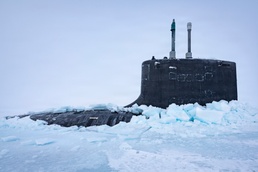
BEAUFORT SEA, Arctic Circle (March 7, 2026)– Commander, Submarine Forces officially kicked off Operation Ice Camp (ICE CAMP) Boarfish in the Arctic Ocean on March 7, 2026, after the building of the camp and the arrival of two U.S. Navy fast attack submarines, USS Delaware (SSN 791) and USS Santa Fe (SSN 763).
ICE CAMP Boarfish is a three-week operation designed to research, test, and evaluate operational capabilities in the Arctic region. In addition to U.S. Navy, U.S. Marine Corps, and Air National Guard participation, personnel from the Royal Australian Navy, Royal Canadian Navy, Royal Canadian Air Force, French Navy, Royal United Kingdom Navy, Norwegian Defence Research Institute, and the Japan Agency for Marine-Earth Science and Technology are also taking part.
This operation, held biennially, partners with the Arctic Submarine Laboratory and was elevated from an exercise to an operation to better reflect the Navy’s strategic priorities in the Arctic. ICE CAMP provides the necessary training to maintain a working knowledge of a constantly changing region.
"The Arctic is a critical region for national security and global stability. Our commitment to a sustained presence and operational readiness here is unwavering," said Vice Adm. Richard Seif, Commander, Submarine Forces. "ICE CAMP Boarfish allows us to test and refine our capabilities, deepen our interoperability with key allies, and ensure our Submarine Force can project power and defend our nation’s interests in any environment, at any time. Our strength in the Arctic is a testament to the skill and resilience of our sailors and partners."
The Navy’s Arctic Submarine Laboratory, a detachment of the Undersea Warfighting Development Center, is the lead organization for planning and executing the operation. ASL serves as the "Center of Excellence" for Arctic matters for the U.S. Submarine Force. The Arctic is experiencing a trend of diminishing sea ice, which increases the likelihood of maritime activity in the region, including trans-oceanic shipping and resource extraction.
The camp, named Ice Camp Boarfish, serves as a command center for conducting operations and research. Established on a drifting ice floe, the camp consists of shelters, a command center, and the necessary infrastructure to safely house and support the multi-national contingent of personnel throughout the operation.
"Leading this multinational team in such a demanding environment is a privilege," said Capt. David Nichols, Officer in Tactical Control of this year’s ICE CAMP. "The complexity of establishing a fully functional base on a moving sheet of ice cannot be overstated. The professionalism and dedication of every service member and civilian here is what makes this vital mission possible. We are focused on executing our objectives safely and effectively, further enhancing our collective readiness for Arctic operations."
The camp gets its namesake from the USSBoarfish(SS 327), aBalao-class submarine commissioned on September 23, 1944.During her service in World War II,Boarfishearned a battle star for sinking two Japanese vessels in the South China Sea.
In 1947,Boarfishserved as the flagship for Operation Blue Nose, the first-ever exploration under the polar ice cap, where she tested new under-ice sonar technology. This historic mission demonstrated that extended under-ice navigation was practical and paved the way for future submarine operations in the Arctic.
Submarines have conducted under-ice operations in the Arctic for more than 60 years. USS Nautilus (SSN 571) made the first transit in 1958, and USS Skate (SSN 578) was the first U.S. submarine to surface through Arctic ice at the North Pole in March 1959. Since those initial voyages, the U.S. Submarine Force has completed 99 such evolutions, with ICE CAMP Boarfish being the 100th.
U.S. Submarine Forces execute the Department of the Navy’s mission in and from the undersea domain. In addition to lending added capacity to naval forces, Submarine Forces are expected to leverage those special advantages that come with undersea concealment to permit operational, deterrent, and combat effects that the Navy and the Nation could not otherwise achieve.
U.S. Submarine Forces and supporting organizations constitute the primary undersea arm of the Navy. Submarines and their crews remain the tip of the undersea spear.
For more information about ICE CAMP 2026, visit www.navy.mil or www.facebook.com/SUBLANT and www.facebook.com/SUBPAC.