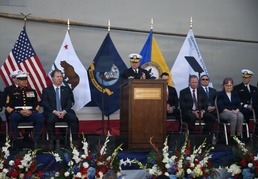
Expeditionary sea base USNS Hector A. Cafferata Jr. (ESB 8) the Military Sealift Command’s newest ship, was christened during a ceremony at the General Dynamics NASSCO shipyard in San Diego, Calif., today.
The event was attended by the family of the ship’s namesake as well as dignitaries including Benjamin C. Kohlman, assistant Secretary of the Navy for Man Power and Reserve Affairs; Carlos Del Torro, former Secretary of the Navy, Vice Adm. John F. G. Wade, commander, U.S. Third Fleet; Rear Adm. Benjamin Nicholson, commander, Military Sealift Command; Sgt. Major Carlos Ruiz, Sergeant Major of the Marine Corps; Marine Col. Jay Vargus, Congressional Medal of Honor recipient; Capt. Alexander Delvers, the ship’s civil service master and employees of NASSCO.
“USNS Hector A. Cafferata Jr. joins a fleet of ships named for warriors who never gave up the fight, putting themselves in harm’s way for their county, their families, and their brothers and sisters in arms – without hesitation,” said Nicholson in his remarks.
The official christening moment happened when Heather Cafferata and Jessica Cafferata, the daughter and granddaughter of Hector Cafferata and the ship's sponsors, broke a bottle of champagne over the ship’s bow with the words, “For the United States, I christen this ship the USNS Hector A. Cafferata Jr. May God protect all who sail on her.”
The ship honors U.S. Marine Corps Pvt. First Class Hector A. Cafferata Jr., who was awarded the Medal of Honor for heroic actions during the Korean War Battle of Chosin Reservoir, November 1950. According to his Medal of Honor citation, during the battle, Cafferata single-handedly held off a regimental-strength enemy and saved wounded Marines by hurling away a live grenade that had landed in their midst, at the cost of serious personal injury.
“Ships take on the spirit of their namesakes,” said Wade. “USNS Hector A. Cafferata Jr. carries forward this legacy of determination and courage. To the mariners and sailors who will operate her, you are inheriting more than a ship. You are inheriting a name built on sacrifice and valor. You will sail far from home. You will support mission that strengthen deterrence and reassure allies. I ask that you lead with integrity, operate professionally and with purpose, care for your shipmates and carry this name with pride.”
Cafferata is the sixth and final ship of the ESB variant of the Expeditionary Transfer Dock platform. ESBs are highly flexible platforms that provide logistics movement from sea to shore supporting a broad range of military operations. The ESB variant is designed around four core capabilities: aviation, berthing, equipment staging area, and command and control. When activated, Cafferata will primarily support aviation mine countermeasure and special operations force missions. In addition to the flight deck, the ship has a hangar with two aviation operating spots capable of handling MH-53E Sea Dragon-equivalent helicopters; accommodations, work spaces, and ordnance storage for embarked force; enhanced command, control, communications, computers, and intelligence to support embarked force mission planning and execution; and reconfigurable mission deck area to store embarked force equipment to include mine sleds and rigid hull inflatable boats.
“We look forward to welcoming USNS Hector A. Cafferata Jr. into our operational family, where it will play a critical role in how the Navy adapts, innovates, and fights,” said Nicholson. “May God bless this ship, all who built her, and all who will sail with her as she carries forward the strength, courage, and spirit of our great nation.”
MSC directs and supports operations for approximately 140 civilian-crewed ships that replenish U.S. Navy ships at sea, conduct specialized missions, preposition combat cargo at sea around the world, perform a variety of support services, and move military equipment and supplies to deployed U.S. forces.