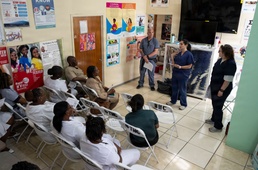
As the Lesser Antilles Medical Assistance Team (LAMAT) 2026 mission concluded in Saint Kitts and Nevis, mental health professionals from the U.S. Air Force and local providers reflect on the partnerships built and the impact of their collaboration on mental health care across the islands.
Working under the guidance of the Ministry of Health, the LAMAT mental health team partnered closely with local clinicians to better understand community needs while supporting care for patients across multiple settings.
“Our team’s role has been to work under the umbrella of the Ministry of Health to assess the needs of our local mental health counterparts and the mental health culture here, said U.S. Air Force Reserve Lt. Col. Dawn Johnson, 349th Medical Squadron clinical psychologist with the LAMAT mental health team.”
The joint effort provided mental health services, including community mental health, outpatient therapy, inpatient treatment and coping skills development, medication management, substance use prevention and treatment, and education to staff and patients about evidence-based interventions.
For both visiting clinicians and local providers, the collaboration became the foundation for delivering care and strengthening professional relationships.
“The partnership built between our local counterparts and the LAMAT 2026 mental health professionals is integral to our success, both in the community and with patients,” Johnson said. “The LAMAT mental health team has been welcomed with open arms and is a relationship built on mutual trust and respect.”
The collaboration also reinforced existing mental health priorities within Saint Kitts and Nevis.
“LAMAT’s mental health team aligned with the Ministry of Health priorities as they offered their knowledge which assisted us greatly in the integration of different services,” said Seana Cuffy, community mental health nurse manager for the Ministry of Health.
Both teams described the mission as a two-way exchange of knowledge rather than a one-sided effort.
“We partnered with our national counterparts to learn from one another and exchange knowledge of best practices, which has led to the mission being mutually beneficial for both nations.”
Local providers also offered critical cultural insight and connections to longstanding relationships within the community, helping ensure care remained responsive to patients’ needs and experiences.
“Watching our local national mental health professionals meet patients where they are, physically, mentally and emotionally has been eye opening,” Johnson said. “Our counterparts will meet patients where they are, in their home, in the clinic, or on the streets, and their relationships with patients are built on years of trust because they’re a consistent presence in their patient’s lives.”
That trust often shapes how visiting clinicians approach care. In some cases, local providers joined counseling sessions to help build rapport and ensure continuity of care.
“Mental health here is stigmatized, similar to the United States, and oftentimes, Kittitians will only talk about their mental well-being with someone they trust,” Johnson said. “One example of us trying to provide culturally responsive care was working with a local doctor in the outpatient psychology department, who often sat in the session with patients to help the local patients know they could trust us.”
For Cuffy, the collaboration strengthened both services and capacity within the local mental health system.
“The primary goal of the LAMAT mental health services demonstrated their skill in the capacity building of our clients and staff in both primary and secondary health care,” she said. “They imparted their knowledge of different skills that we can use to strengthen our mental health services.”
The partnership also highlighted several challenges facing mental health providers in the region.
“The social determinants that we are experiencing on our island manifests quite heavily in our clinics in the psychological aspect,” Cuffy said. “We see clients show up with parental neglect, drug culture, non-stability in their homes, trauma, increased PTSD and substance abuse.”
Recognizing the complexity of these challenges, visiting and local providers used the mission as an opportunity to share knowledge and discuss approaches to patient care, ranging from formal, classroom based education to more informal dialogues about evidence-based treatments, ethical guidelines, and cultural sensitivities.
The exchanges were designed to strengthen local mental health capacity beyond the duration of the mission.
“During LAMAT 2026, we utilized several knowledge exchanges to build the capacity of the local nursing staff, psychologists, psychiatrists, social workers and counselors,” Johnson said. “Additionally, we welcome continued consultation because we recognized that training is best done both with knowledge and experience.”
For many providers involved, the most meaningful moments came through patient interactions. “One of the most meaningful impacts I’ve been privy to is engaging in mental health treatment and her telling me, ‘I feel like I’ve gained my life back because of this,’ referring to the work we did together,” Johnson said. “As a provider, that is gold, and it’s why I do what I do.”
Reflecting on the experience, Johnson described the collaboration in two words. Life changing.
“I would describe this collaboration as life changing,” she said. “I plan to take what I learned here to serve not only in my local area but also in missions in other areas of the world.”
Cuffy said she hopes the partnerships formed during the mission will continue to grow in the future.
“I would like to see future collaboration with the LAMAT Mental Health team … We can assist each other in partnerships, knowledge exchange, narrowing the gaps, formulation of policies, and training and goal accomplishments,” she said. “As we all know, there’s no good health without good mental health.”