By ANDREW REDWINE
SIAD safety and occupational health specialist
ANN ZANIEWSKI
TACOM Public Affairs
SIERRA ARMY DEPOT, Calif. – Employees of Sierra Army Depot’s AJ1-SSA Disposal Branch were recently honored for their exceptional work in processing and disposing of more than 2,000 legacy radiation waste items, some of which contained a substance that is critical to U.S. defense and technology.
The workers recovered 95 kilograms of germanium from obsolete optics and other materials and sent the valuable metalloid to a recycling center to be processed for future use. Their efforts reflect a heightened focus across the U.S. Army Tank-automotive and Armaments Command on ensuring the proper disposal of radioactive material.
Germanium is primarily a byproduct of zinc ore processing. A semiconductor with electrical properties that lie between those of a metal and an insulator, it is widely used in optics and electronics, with applications in thermal imaging cameras, solar cells and space technologies. Germanium was designated a strategic and critical material in the 1980s and remains an essential component of the National Defense Stockpile.
In 2024, as a backlog of legacy radiation waste items was being processed at SIAD, representatives from the Joint Munitions Command (JMC) offered the expertise of a technician from its low-level radiation waste program. A representative from TACOM’s Radiation Safety Team also traveled to the depot to provide assistance.
The JMC representative identified germanium-containing items while on site and recommended the depot contact Defense Logistics Agency (DLA) Strategic Materials for further guidance. DLA Strategic Materials is the leading U.S. agency responsible for analyzing, planning, procuring and managing materials critical to national security. This program oversees the complete process from demilitarization to ingot production for military-grade germanium components.
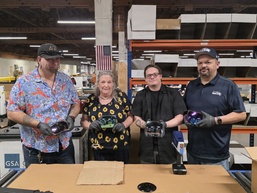
Subsequently, DLA representatives visited SIAD and trained two AJ1-SSA materials examiners and identifiers, Nancy Hughes and Erik Sanchez, on how to identify likely germanium-containing items and confirm the metalloid's presence. Hughes also attended a Transportation of Radioactive Materials course conducted by a Naval Sea Systems Command instructor in April 2024 to earn the certification necessary for shipping these items. SIAD’s Safety Division later purchased an X-ray fluorescence analyzer (XRF) gun, which team members can use whenever they suspect an item contains germanium.
Utilizing their newly acquired knowledge, Sanchez and Hughes developed an efficient process for disposing of radiation items, including those containing germanium, within AJ1-SSA. Through meticulous processing, they recovered and shipped 95 kilograms of germanium to the DLA Strategic Materials Germanium Recycling Program, generating an estimated $465,000 in cost savings for the U.S. government. Wesley Waters, MEI supervisor, played a crucial role in encouraging and facilitating the project's execution.
This achievement reflects the professionalism, dedication and expertise of a team that worked nearly a year to complete this challenging task. Their efforts exemplify the depot's commitment to excellence and mission success.
Other TACOM sites have similar initiatives underway regarding the disposal of legacy radiation waste items, said Nathan Krzyaniak, supervisory health physicist for the TACOM Safety Office and the command’s lead radiation safety officer. He noted that Anniston Army Depot and Rock Island Arsenal-Joint Manufacturing and Technology Center have XRF guns, with future work to recover germanium optics pending at both locations.
Over the past five years, Krzyaniak has worked to drastically reduce the inventory of radioactive material in TACOM’s portfolio and replace those items with non-radioactive equivalents. He said the command eventually wants to end its liabilities associated with maintaining radioactive material licenses.
“Getting this material properly dispositioned is important and should be a continuous focus,” he said.