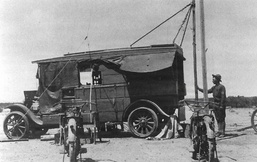
On Mar. 11, 1918, the Secretary of War formally approved the creation of a Radio Intelligence Service (RIS) to intercept Mexican radio communications. The RIS then established mobile radio intercept stations along the U.S.–Mexico border that captured communications confirming Mexico–Germany collaborations during World War I.
The Signal Corps began intercepting Mexican radio communications as early as 1915. Initially, these were simply sporadic operations carried out when time permitted by standard radio communicators at border posts. However, in March 1917, the revelation of the Zimmermann Telegram made it acutely obvious Germany was using its long-distance radio communications capability to foment adversarial activity inside Mexico against the United States. About this time, the Signal Corps began experimenting with dedicated intercept stations on the border, but a lack of trained personnel led to their abandonment after just a few months. The threat of active German agents both inside and just outside America’s borders continued.
In late December, Maj. (later Maj. Gen.) Ralph Van Deman, chief of the War Department’s Military Intelligence Division (MID), asked the Signal Corps to send an officer to the border to determine the extent of German propaganda being sent via radio to Mexico. Van Deman specifically wanted Maj. Carl Kinsley, a highly educated physics professor who had assisted in the Signal Corps’ first successful wireless technology experiments in 1899. The 47-year-old Michigan native had been commissioned just a few months before conducting Van Deman’s requested inspection of existing Signal Corps radio stations at military posts along the border.
On Jan. 17, 1918, Kinsley delivered his report to Van Deman, triggering a flurry of activity. First, Van Deman established the MI-10E Radio Interception subsection within his MI-10 Censorship section. Then, on Feb. 16, he had Kinsley reassigned to the MID to oversee the new subsection. A week later, on Feb. 22, Kinsley established the Radio Intelligence Service (RIS), which was formally approved by Secretary of War Newton D. Baker on Mar. 11.
Between March and December 1918, the RIS established fourteen mobile stations along the southern border—in Laredo, McAllen (three stations), Del Rio, San Antonio (two stations), Sutherland Springs, and Pecos, Texas; Las Cruces (two stations) and Lordsburg, New Mexico; and Tucson, Yuma, and Nogales, Arizona—to intercept and copy messages sent out by Mexican stations. Additional fixed stations operated from the U.S. Embassy in Mexico City and from Houlton, Maine. Signal Corps operators manning stations at the southern border were told to pay particular attention to any messages sent to European stations, submarines, or other Mexican stations.
Although the RIS never reached its total authorized personnel, by November 1918, it employed sixteen lieutenants and eighty-four enlisted men. Each station operated around the clock, in six shifts, from systems mounted in trucks referred to as “radio tractors.” These Radio Tractor Units (RTUs) were alternately referred to as “Radio Training Units” to hide the secret nature of their operations. Copied coded messages were sent for analysis to the MID’s MI-8 Cable and Telegraph Section that handled codes and ciphers.
The RIS collected about 60,000 messages during the last eight months of World War I. Reportedly, these messages provided some information of value about Mexico–Germany relations, but they revealed more about military, political, and economic conditions in Mexico, information that was shared with the Departments of State, Justice, Treasury, and Navy. The RIS was mostly disbanded at the end of the war. Most of the stations closed in the summer of 1919, but a few continued to operate into 1920 under the administration of the Signal Corps, while MID focused its attention on the cryptanalysis of any coded messages the stations intercepted.
Article by Lori S. Stewart, USAICoE Command Historian. New issues of This Week in MI History are published each week. To report story errors, ask questions, request previous articles, or be added to our distribution list, please contact: TR-ICoE-Command-Historian@army.mil.