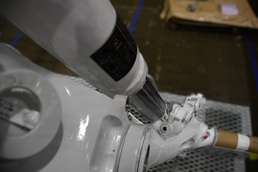
Fleet Readiness Center Southwest (FRCSW) has once again proven that America’s strength lies not only in its aircraft and equipment but in the dedicated hands and innovative minds of the men and women who maintain them. The command’s groundbreaking effort to overhaul and recoat the F/A-18 Landing Gear (NLG) has become one of the most successful new initiatives in the FRC enterprise, one that directly supports the President’s National Defense Strategy.
Until recently, FRCSW had only repaired individual landing gear components as they came off the aircraft. Now, the command is taking on an entirely new challenge, processing entire shipsets of landing gear at once, inspecting, disassembling, recoating, reassembling, and returning them to the fleet in full working order.
This shift is a transformation in how FRCSW supports the fleet. The overhaul cycle implemented every 6–8 years, involves removing the full landing gear from the aircraft, replacing all protective coatings, and sending it back to the customer as a complete, tested assembly. What began as a seemingly impossible task in 2021 has evolved into a model process of innovation and teamwork.
When this new workload began, no one, not FRCSW artisans, the Original Equipment Manufacturers (OEMs) or any other military commands, had the information or processes for these repairs. FRCSW’s engineers, artisans, and leaders stood at the forefront in developing brand-new technical data, tools, and standard operating procedures.
More than 150 new routers were generated for previously untouched parts, (a router, or work order, is an internal document that tells personnel where a part is going and what needs to be repaired). FRCSW personnel translated complex external technical data into steps they could execute with precision. Every element, from how to transport the landing gear to how to reassemble it, had to be created from scratch.
During this effort the team’s creativity shone through on every front. Dan Doyle, FRCSW Production Manager, devised a colored coding system for work orders allowing parts to be easily tracked throughout the process. Angela Gutierrez, FRCSW Production Manager, realigned limited personnel resources and changed the footprint of the landing gear shop to accommodate the overhaul. Gary Rice, Spencer Leonard, and Aaron Wilcher each played vital roles: Gary kept production control and logistics on track, Spencer led as the project coordinator ensuring visibility of every task, and Aaron engineered efficient kitting systems, streamlining repairs and cutting turnaround times.
Through government shutdowns and logistical challenges, the FRCSW team persevered, identifying alternate facilities, adapting timelines, and sustaining mission-critical tempo to keep the line moving.
True to the commands legacy of innovation, the team faced and solved complex engineering challenges head-on. Under the leadership of John Kucharski, F/A-18 Fleet Support Team (FST) Landing Gear Engineer and the Materials Lab, the command developed a revolutionary primer wipe technique to replace a specialized chrome seal, a major breakthrough validated by the OEMs. The primer wipe not only met but exceeded the performance of the unavailable chrome seal, marking a huge win for the Navy, Marine Corps, and industry partners.
The command also leveraged the expertise of its award-winning Cold Spray team, using advanced “supersonic metal spraying” to rebuild corroded aluminum housings, a critical technology bridging shortages in manufacturing new parts. This innovation ensures that Navy and Marine Corps aviators continue to have the tools they need to defend the nation without delay.
FRCSW leaders such as Brianna Timothy, FRCSW Deputy Program Manager - Components, recognized early on that success would require strong, collaborative partnerships. Today, the command’s ongoing partnership with Boeing on the NLG shipsets is entering its second contract, exemplifying this teamwork. Weekly meetings keep communication flowing, and the contract has more than doubled in size, proof of mutual trust and success between these partners.
Collaboration with Heroux-Devtek Incorporated (HDI), Safran, and Naval Supply Systems Command (NAVSUP) also strengthened the program. When one organization identifies a portion of the process that another can perform more efficiently, parts are shipped accordingly, ensuring the fastest, most accurate results for the fleet. The result is a truly integrated enterprise system that benefits all parties and, most importantly, the warfighter.
To date, FRCSW has completed three main landing gear (MLG) shipsets and one nose landing gear (NLG) shipset with plans to increase production to 18 full sets per year. The success of this initiative demonstrates not only technical mastery but the immense pride and dedication of the workforce. This effort is in addition to the team’s established workload, over 2,400 parts processed each year, a testament to their tireless commitment to the command’s mission.
Every artisan, engineer, and leader involved in this program has played a role in advancing the readiness and lethality of the U.S. Navy and Marine Corps. Their work ensures that our warfighters continue to operate with confidence, knowing their aircraft are maintained by the best of the best.
At its core, this achievement is more than metal, coatings, and machinery, it’s about people. It’s about the men and women of FRCSW who embody the American spirit of problem-solving, innovation, and service to the nation.
Through determination, skill, and teamwork, FRCSW has set a new standard in readiness and operational support, demonstrating that when challenges arise, American’s rise higher.
FRCSW employees are the Backbone of Military Readiness!