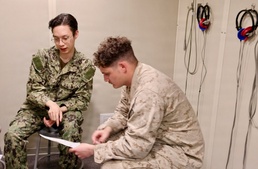
TWENTYNINE PALMS, Calif. — When Lt. Christopher Barajas arrived at Navy Medicine Readiness and Training Command (NMRTC) Twentynine Palms, which supports Naval Hospital Twentynine Palms, in December 2024, he quickly recognized a challenge facing the installation’s hearing conservation program: service members needed audiograms to remain medically ready, but the primary testing site was filling its walk-in capacity within minutes each morning.
Barajas, an occupational audiologist assigned under the Bureau of Medicine and Surgery (BUMED), is now leading a process improvement initiative designed to expand testing access, better utilize existing resources across Marine Corps Air Ground Combat Center (MCAGCC) Twentynine Palms, and ultimately help commands meet hearing conservation requirements.
“The Digital Appointment Portal (DAP) is an online system service members can use as of March 2026 to secure their next audiogram,” Barajas explained. “There are four surveillance audio booths around the command. One of those booths is used regularly while the other three struggle to maintain consistent usage.”
The Adult Medical Care Clinic (AMCC) audiometric booth has historically served as the primary location for hearing screenings, which created a bottleneck during busy periods—particularly during pre-deployment preparation cycles.
“Many service members were being turned away for an audiogram at the AMCC because all available walk-in slots were consistently filled within 30 minutes of opening the clinic,” Barajas said. “The current capacity of the AMCC audiometric booth is 84 patients per day.”
To address the issue, Barajas introduced a hybrid system using the Digital Appointment Portal. While walk-in services remain available, half of the testing slots at the underutilized booths are now reserved for scheduled appointments through the online system.
“We will still offer walk-in audiograms, but half of the spots available—three every 30 minutes—will be reserved for the DAP,” Barajas said.
The approach is designed to better distribute patients across the installation’s four available audiometric booths, reducing congestion at AMCC while increasing overall testing throughput.
The improvement comes at a critical time for the command’s hearing conservation program. Approximately 13,000 service members and civilian personnel at MCAGCC Twentynine Palms are enrolled in the program and require periodic hearing screenings to ensure compliance with Department of War medical readiness standards.
“During active preparation for deployment cycles, we tend to see all 84 spots filled within 30 minutes of the clinic doors opening that day,” Barajas said. “Outside these time periods, a steady average of 70 to 75 audiograms are conducted each day.”
By activating additional testing sites and incorporating appointment scheduling, Barajas expects to significantly increase the number of screenings performed daily.
“With this process improvement, we will increase our current testing capacity by 252 slots,” he said. “My hope is that we increase daily audiogram count from 84 to 200 screeners per day.”
That increase would provide commands greater flexibility in maintaining compliance with hearing conservation requirements, which mandate that at least 85 percent of eligible personnel complete annual hearing screenings.
Barajas noted that hearing readiness plays a direct role in mission effectiveness.
“The pitches tested in a standard hearing screener cover the range of frequencies we use for human speech,” he said. “Clear communication out on the field is a requirement for a successful mission.”
Routine screenings also help identify early signs of hearing loss, allowing medical staff to intervene and provide treatment or protective measures before the condition worsens.
“Hearing screeners with abnormal results provide our department with an excellent opportunity to intervene and facilitate assistance the service member may need to perform well on the job,” Barajas said.
To support the increased testing capacity, the hospital expanded the number of trained personnel capable of conducting audiometric screenings. In December 2025, the command added three corpsmen to the audiology team, allowing the department to operate additional booths and process more patients.
Corpsmen assigned to the program complete specialized training taught by Barajas.
“Corpsmen may elect to take a weeklong course with me to learn about the pathway sound takes through the ear,” he said. “During this course, I equip my students with knowledge to know what contributes to abnormal test results and what the next proper echelon of care would be when completing that referral.”
The training program, offered at least once per quarter, provides both clinical knowledge and professional development opportunities for participating Sailors.
“The audio tech courses I teach at the command are nationally recognized through an organization called CAOHC (Council for Accreditation in Occupational Hearing Conservation),” Barajas said. “This gives students an opportunity to take an extra test at the end of the course and earn a certification required for a well-paying job with the Department of the Navy or Veteran Affairs as a civilian audio technician. So really it’s also an excellent investment in their professional development if they find that they want to work in the field longterm.”
In addition to expanding capacity within the clinic, Barajas has strengthened coordination with units across MCAGCC Twentynine Palms to ensure commands remain compliant with hearing conservation requirements.
“Upon request, I can send out projected readiness numbers for hearing conservation to a command’s safety officer,” he said. “These reports show how many audio screeners a command needs to meet the medical readiness requirement.”
If a unit falls behind in completing required screenings, the audiology department can coordinate targeted events to help close the gap.
“If a command is at risk for not meeting the minimum requirement, we offer private standdowns at an audio booth,” Barajas said. “Here, a command can conduct as many audiograms as they need to remain in compliance with the hearing conservation program.”
The digital scheduling model itself is not entirely new to Navy Medicine. Barajas previously saw a similar system used successfully at Marine Corps Recruit Depot (MCRD) San Diego and adapted the concept for the operational environment at Twentynine Palms.
“The Digital Appointment Portal was designed around 2020–21 and was originally meant for patients to see providers during the COVID lockdown,” he said. “The Occupational Audiology clinic at MCRD San Diego uses the DAP for a similar purpose.”
At that command, the system proved effective in balancing walk-in access with scheduled appointments—an approach Barajas believes will deliver similar results at MCAGCC.
Hospital leadership has supported the initiative from its early stages.
“Hospital leadership has been very supportive throughout this whole process improvement project,” Barajas said. “Our Command Master Chief, Richard Moreno, equipped our Audiology department with corpsmen to train and conduct audio screeners while facilitating excellent hearing health care for our service members.”
He also credited mentorship from the hospital’s public health leadership for helping communicate the initiative across the command.
“Our Director for Public Health, Cmdr. Christina Carter, helped showcase this project to leadership to demonstrate how it can bolster readiness and overall is an excellent mentor when I need it,” Barajas said.
Beyond routine readiness requirements, audiograms also play a key role in documenting service members’ hearing health throughout their careers.
“The audiology booth at the AMCC is a mandatory stop for service members when they prepare to deploy,” Barajas said. “A pre-deployment audiogram is conducted during that time and is meant to track any changes in hearing that occur during their upcoming deployment.”
The screenings also serve as an opportunity to reinforce hearing protection practices before Marines and Sailors enter high-noise training or operational environments.
“This is also an excellent opportunity for our department to educate service members on proper hearing protection usage in an effort to mitigate permanent hearing loss during training,” Barajas said.
Service members are also screened again before permanent change of station or separation from the military to document any changes in hearing accumulated during their service.
“I use this opportunity to identify weaknesses in our current protocol and recommend changes to our system that will better preserve our service members’ hearing ability,” Barajas said.
Through expanded training, improved scheduling, and stronger collaboration across the installation, Barajas’ process improvement initiative is helping strengthen a critical component of operational readiness—ensuring Marines and Sailors can hear clearly when it matters most.