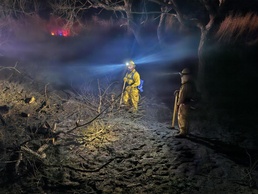
As wildland fires tore across western Kansas in February, Tech. Sgt. Chase Garza, an airman assigned to the 184th Wing, Kansas Air National Guard, deployed as a crew chief to Garden City and Liberal with the Kansas National Guard wildfire task force. This operation highlighted the Guard’s evolving role in domestic emergency response throughout the state of Kansas.
His primary mission was to lead his engine crew in direct attack and mop-up operations, extinguishing stubborn hot spots and ensuring the fire-ravaged terrain would not reignite.
Garza’s crew was praised for its innovative and highly efficient approach. By combining a multi-tool attack, like using hand tools such as Pulaskis and McClouds to dig at fire edges while a hose team provided support, they were able to contain ground fires with impressive speed.
This dynamic strategy, driven by experience and necessity, proved critical in the demanding environment of a wildland fire.
A Desire to Serve
For Garza, the path to serving as a volunteer firefighter began in 2020 with a simple, driving motivation.
"I got involved with wildland firefighting after I expressed extensive interest in Domestic Operations," Garza explained. "I wanted above all else to help others, after all that is why I joined the National Guard."
At the time, the program was primarily managed by the Army.
Garza completed the foundational Wildland Firefighter Type II (FFT2) certification, a series of courses covering everything from firefighter training and fire behavior to the Incident Command System that governs all emergency responses. This training, he notes, is the baseline for all members.
Lessons from the Fire
During the recent support operations, Garza put his years of training and experience to the test, drawing critical lessons from the high-stakes environment. He credits the mission's success to a culture of trust and autonomy.
"One of the strongest takeaways was the value of operating autonomously once given a location and objective," Garza said. "Micromanagement from higher positions slows responses and stifles initiative. In dynamic wildland environments, fires don't wait for approvals."
That trust empowered him to make real-time decisions about resource allocation. He learned that over-relying on traditional hose lays wasn't always the best approach.
"I learned quickly that multi-tool coordination often achieves the same, or better, results as laying hose lines. [It is also] sometimes faster, with less setup/teardown and water use," he noted. "Choosing the right method conserves water, reduces fatigue, and keeps the engine mobile."
Garza emphasized that a crew chief’s responsibility extends far beyond just fighting the fire, it's about ensuring the crew's survival. He drilled his team on non-negotiable safety protocols, like driving a "circle recon" to confirm an exit before entering a dangerous area and constantly verbalizing escape routes.
"The engine is my crew's lifeline for egress, water, and mobility," Garza stated. "Poor positioning can turn a routine mop-up into a life-threatening situation."
Ultimately, he attributes the crew's success, which consisted of a joint team of three Army Soldiers and one Airman, to teamwork and shared knowledge.
"Despite working for different branches of the military and me being placed into a leadership position, my crew gelled quickly,” Garza explained. “We addressed hiccups on the spot and improved speed through learned tips, especially given my prior training with the 184th Wing Wildland Fire Team."
Answering the Call
Becoming a certified wildland firefighter in the Kansas National Guard requires a significant commitment to both physical fitness and advanced, specialized training. The team is always looking for additional drill-status Guardsmen to join.
The journey begins with the Wildland Firefighter Type II (FFT2) certification, which includes:
S-130: Firefighter Training
S-190: Introduction to Wildland Fire Behavior
L-180: Human Factors in the Wildland Fire Service
ICS-100 & IS-700: FEMA-based incident command training
For those seeking to deploy to other states with forestry services, a physical fitness test of carrying a 45-pound pack over three miles in 45 minutes or less is required. From there, Guardsmen can pursue advanced qualifications, including:
Firefighter Type I (FFT1)/Squad Boss: A leadership role for supervising small crews.
Faller (FAL3 & FAL2): Specialized chainsaw operators responsible for felling trees.
Engine Operator (ENOP): The expert responsible for operating and maintaining the fire engine.
Each advanced certification requires annual refreshers, further classroom and field work, and the completion of a task book to demonstrate proficiency. It is a continuous process of learning and development for Guardsmen like Garza who stand ready to help suppress future fires.