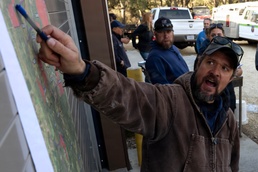
Wildland firefighters from across the country gathered to carry out a series of controlled fires
over the course of approximately two weeks, beginning Feb. 9.
The fires are part of a five-year burn plan developed by the 802d Civil Engineer Squadron
natural resources office in partnership with the military training units who use the land.
According to the U.S. Department of Agriculture’s Forest Service, burn plans identify, or prescribe, what the ideal burn conditions are for the desired results. Outlined conditions include factors such as temperature, humidity, wind and moisture of the vegetation.
“The main purpose of conducting prescribed burns is to get rid of the mastication, or mulch debris, and associated ground fuels in order to reduce wildfire risk,” Bryanna Lawrence, 802d CES cultural and natural resources chief said. “By burning off the dry ground fuels, new green vegetation is able to come back up and really help the surrounding environment, which in turn helps maintain realistic training for the military mission.”
Experts from agencies such as the Air Force Wildland Fire Branch, U.S. Department of the Interior’s U.S. Wildland Fire Service and local fire departments intentionally ignite controlled fires within specific, inactive units on the installation each year of the plan. The teams work to remove damaged and dead vegetation that could fuel unintended wildfires while healthy, mature plant life survives the quick moving fire due to natural adaptations or interventions such as firefighters moving nearby mulch.
Joint Base San Antonio Fire and Emergency Services, assigned to the 502d Civil Engineer Group, provided a dedicated water supply via a 5,000-gallon water tender and a 4,000-gallon portable drop tank as well as Red Card–certified firefighters who met wildland fire training and. annual fitness requirements.
“This setup ensures a sustained and immediately accessible water supply throughout the burn,” said fire Capt. Eric Watkins, 902d CES JBSA FES wildland fire program manager. “In addition to supporting ignition and holding operations, our crews remain fully staffed and ready to respond if fire behavior exceeds the planned burn area, allowing for rapid suppression and protection of personnel, infrastructure and natural resources.”
The areas are then monitored between burns to ensure there is a healthy, maintainable variety of growth to support wildlife, including the endangered Golden-cheeked Warbler, and training objectives involving skills such as land navigation.
“Training doesn’t like [mulched vegetation] throughout their training units and they just want to be able to work out here,” Lawrence said. “We’re trying to get the terrain ready for them.”
In addition to transforming the land, conducting prescribed burns allows local fire departments the opportunity to build working relationships and helps firefighters train to combat real wildfires.
While they train for the worst, the teams actively work to reduce the likelihood of putting that training into action.
“There have been a lot of studies done on prescribed fire … where prescribed fire has actually stopped a wildfire from getting too big or out of control,” Blake Stewart, U.S. Air Force Wildland Fire Branch burn boss, said. “If we do have a wildfire here at Camp Bullis, this does make it easier to contain and control. It’s better for firefighter safety, for public safety. It makes our jobs as wildland firefighters way easier to go into an area that’s already been burned, even two or three years down the road. It’s still easier to contain, it’s easier to control and keep fire on base or prevent fire from coming on base.”