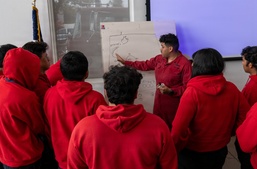
Seven years after graduating from Franklin Police and Fire High School,Fire Controlman Aegis 1st Class Angel GermanHerrera, a Navy recruiter assigned to Navy Talent Acquisition Group Phoenix, returned to his alma mater to introduce students to the Navy’s approach to firefighting and shipboard emergency response.
Franklin Police and Fire High School specializes in firefighting and law enforcement education, making it an ideal environment for a hands-on demonstration of Navy Damage Control procedures. After coordinating with the school, GermanHerrera organized a drill modeled after a Navy8010 manual firefighting scenario, allowing students to experience how Sailors respond to emergencies at sea.
“It was a surreal moment for me,” said GermanHerrera. “To return and share my life experiences with students who were in my shoes seven years ago.”
Drawing from his experience, serving aboardthe Arleigh Burke-class guided-missile destroyer USS Sampson (DDG 102)as a member of the ship’s flying squad, GermanHerrera created a watch bill modeled after an at-sea fire party and assigned students to positions based on the class roster. Students then executed the drill under a structured chain of command similar to how Sailors respond during shipboard emergencies. Because many of the students already receive firefighting instruction through the school’s public safety curriculum, they were able to quickly apply their training to the Navy-style evolution.
“This drill reflected both U.S. Navy shipboard firefighting and college-level structural firefighting training,” said William Pech, a fire science teacher at Franklin Police and Fire High School. “Students operated within a clear chain of command, practiced effective communication, and followed proper safety procedures. These elements are essential in both military and civilian firefighting environments.”
The simulated fire exercise allowed students to apply core firefighting skills such as scene size-up, teamwork, and the use of protective equipment while also experiencing the unique demands of shipboard emergency response. GermanHerrera explained that while the fundamentals are similar, naval firefighting often involves additional complexities.
“Navy firefighting is much more intense and fast paced,” GermanHerrera said. “If timelines aren’t met, it can result in cascading damage to the ship and risk to your shipmates. That level of urgency makes teamwork absolutely critical.”
Pech noted that the Navy’s approach expands beyond traditional structural firefighting.
“In our program students focus on fire behavior, hose management, search and rescue, and ventilation,” Pech said. “In contrast, the Navy must also address flooding, structural integrity, and overall ship survivability while combating a fire.”
Students responded enthusiastically to the hands-on drill, successfully executing their assigned roles and asking questions about naval service afterward.
“I noticed an increase in curiosity and engagement about naval service, especially among my firefighter students,” Pech said. “They were intrigued by how firefighting skills translate into a military setting and surprised by the level of discipline and coordination required aboard a naval vessel.”
For GermanHerrera, the most memorable moment came during the post-exercise debrief.
“The excitement and motivation during the debrief showed just how much they enjoyed it,” said GermanHerrera. “Their response and accuracy were amazing. With some time, they would definitely be a seaworthy team.”
The event also carried special meaning for the school community, as students saw a former graduate return in uniform.
“Having an alumnus return in uniform is a powerful moment for our school,” said Pech. “It shows students what dedication and commitment can lead to after graduation and reinforces the strength of our Police and Fire program.”
GermanHerrera and Franklin teachers want to continue collaboration with similar engagements.
“Partnerships like this provide our students with valuable real-world insight and exposure to career pathways they may not have previously considered,” said Pech. “Continued collaboration would greatly benefit our students and support the mission of our public safety program.”
GermanHerrera said he hopes the exercise leaves students with a lasting understanding of how teamwork drives success in the Navy.
“Firefighting is universal,” said GermanHerrera. “The skills they’re learning now can translate directly to the Navy. More importantly, the Navy relies on teamwork. Shipmates always depend on each other, and damage control is vital to everything we do.”
NTAG Phoenix’s area of responsibility includes more than 37 Navy Recruiting Stations and Navy Officer Recruiting Stations spread throughout 250,000 square miles of Arizona, New Mexico, Texas, and Colorado.