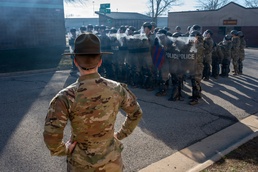
FORT LEONARD WOOD, Mo. — Fort Leonard Wood trainees learning to serve as military police Soldiers spend four of their last few days of initial entry training focusing on the role of law enforcement and policing a U.S. Army Garrison — safeguarding service members, civilians and their families, as well as maintaining law and order at home.
According to 14th MP Brigade Command Sgt. Maj. Gregory Elderkin, the Sword Law Enforcement Exercise is an intensive exercise serving as a capstone, testing the skills learned in a realistic environment.
“Soldiers are exposed to a wide array of situations they may face in the field, such as domestic disputes, non-compliant subjects and traffic stops. By working in rotating shifts over several days, Soldiers experience physical and mental fatigue that is a common aspect of law enforcement,” Elderkin said.
The exercise is completed by all MP one station unit training Soldiers who are earning the military occupational specialty of [31B Military Police](https://www.goarmy.com/careers-and-jobs/support-logistics/safety-order-legal/31b-military-police).
“Soldiers who are earning the MOS of [31E Corrections and Detention Specialist](https://www.goarmy.com/careers-and-jobs/support-logistics/safety-order-legal/31e-corrections-detention-specialist) will conduct a similar exercise where they manage and operate a fully functioning confinement facility, to include shift work, for several days,” Elderkin added.
Pfc. Aidan Young, a 31B MP Soldier in training, with Company B, 787th MP Battalion, said the Sword LEX made him feel like, “I am actually serving as an MP this week.”
“It is a mindset and I feel ready,” he said.
Some of the duties Soldiers take turns performing during the exercise include working different shifts at the mock police station at Brig. Gen. David H. Stem Training Village, commonly referred to as Stem Village, and patrolling in vehicles while responding to more than 100 calls, including impaired drivers and high-risk traffic stops, a mental health crisis, domestic dispute, active shooter and crowd-control scenarios.
Staff Sgt. Christopher Arcia, a drill sergeant with Company B, 787th MP Bn., served as the noncommissioned officer in charge of his unit’s Sword LEX.
“I coordinated the plan and logistics for this four-day exercise, to include all the calls the MPs received,” Arcia said. “It is train as you fight and I tried to incorporate as much realism into this exercise as possible.”
He said the goal is for his MPs to leave Fort Leonard Wood as well-rounded, agile Soldiers that are multi-purpose tools for the Army.
During the company’s Sword LEX, Young, who serves with the Tennessee Army National Guard, said his shifts were going “smoothly” and he was “confident” in his ability to respond to any situation.
“I was able to get to my calls quickly this morning and my drill sergeants said I did well. All these calls seemed very realistic and make me feel prepared to perform my future duties in the real world,” Young said.
While planning the riot control portion of the exercise, Arcia said he focused on testing their ability to rely on their use of force knowledge.
“Learning to manage stress is a very important part of our training,” Arcia said. “They are taught to handle everything at the lowest level of force to de-escalate the situation.”
According to Elderkin, crowd-control training has been a part of MP curriculum for several decades.
“This training is a critical component of preparing Soldiers for a wide range of situations, from civil disturbances to full-blown riots. MPs are trained in various riot control formations that allow them to move as a cohesive team while controlling crowds and protecting themselves and others,” Elderkin said. “The training includes a strong emphasis on the legal and ethical aspects of riot control to include understanding and adhering to situational de-escalation, levels of force and rules of engagement.”
While the training isn’t new, Capt. Carlos Paiz, Bravo Company, 787th MP Bn. commander, said incorporating crowd-control training into the Sword LEX is.
“Bravo Company was the first company in the 14th MP Bde. to integrate the civil disturbance mission of riot control to the MP OSUT Sword LEX,” he said.
According to Arcia, crowd control training allows MPs to learn to be comfortable wearing riot gear as their senses are being bombarded by battle buddies waving signs, yelling through megaphones and pushing them, while sight obscuring smoke is being pumped into the air.
Soldiers playing the role of protestors were instructed to grow more disorderly with their actions and words as time went on. Role-players were authorized to push, strike and grab shields, grab equipment if loose or accessible and actively resist during the simulation.
“My battle buddies who were pretending to be protesters pulled my shield down and pushed me. But our drill sergeants warned us it might be like that, so I was able to keep my composure and de-escalate the situation,” Young said. “Our goal is to make sure nobody gets hurt while restoring order.”
Arcia said he was impressed by the Soldiers’ performance during the Sword LEX, and he is “proud” of the new U.S. Army MP Corps members.
According to Elderkin, the 14th MP Bde. is committed to the MP Corps’ ongoing evolution and transformation of MP law enforcement training programs.
“It is a strategic imperative that we stay abreast of the situations military police professionals are facing in the field and continuously evaluate and modernize the professional training doctrine for our Soldiers,” Elderkin said.
“We continuously work in collaboration with the U.S. Army Military Police School to add updated training and relevant scenarios to the law enforcement curriculum.”