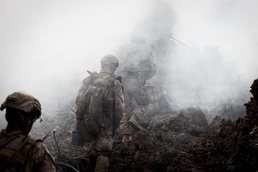
MARINE CORPS BASE HAWAII, Hawaii -- U.S. Marines and Sailors with 3rd Marine Littoral Regiment executed a suite of dry-fire and live-fire ranges that concluded with a Marine Corps Combat Readiness Evaluation, February 6-11, 2026. The series of ranges and subsequent evaluation validated weapon system and tactical proficiency, bolstering warfighting readiness and preparing the unit for future operational requirements as a premier Stand-in Force within the Indo-Pacific.
A MCCRE is a formal evaluation derived from Marine Corps Training and Readiness standards and assigned Mission Essential Tasks, serving as a critical test to ensure standardization for operational deployments.
“It was important to create a scenario that was threat- and adversary-informed,” said Lt. Col. Joshua Anderson, a future operations planning officer with 3rd Marine Littoral Regiment and the exercise director of the MCCRE. For 3rd Littoral Combat Team and 3rd Littoral Logistics Battalion, this evaluation provided a realistic, scenario-based rehearsal to refine the subordinate battalions’ unique capabilities across islands in the Hawaiian archipelago.
On the Big Island of Hawaii, Pohakuloa Training Area served as the center for 3rd MLR and its subordinate battalions to branch out and rehearse distributed maritime operations.
“PTA is a crucial training area for us; we are very limited to doing squad attacks, fireteam attacks, and [refining] basic skills while on Oahu,” said Capt. Jason Black, a company commander with 3rd LCT. “We were able to execute some platoon attacks [on Oahu], but this is the only place in the Hawaiian archipelago where we can execute company live-fire attacks and knock out a lot of that integration sequencing and the inclusion of all those agencies.”
Key events included Marines with the 3rd LCT executing dry-fire and live-fire ranges to sustain tactical proficiency prior to the MCCRE. Marines with 3rd LLB conducted Helicopter Support Team training to refine their logistical prowess, facilitating the coordination and movement of personnel and equipment across the island chain. Simultaneously, Marines from the regimental headquarters element conducted distributed command and control operations and tactical displacement drills based on the Expeditionary Advanced Base Operations and the execution of command and control in distributed maritime operations concepts.
At the start of the MCCRE, 3rd LCT distributed its companies to several different locations across the Hawaiian archipelago, including the Pacific Missile Range Facility on Kauai, and Kahuku Training Area and Marine Corps Training Area Bellows on Oahu.
“Their ability to employ their formation in various locations across different islands shows they understand how to conduct distributed operations in a maritime environment. This allows for more survivability of the formation while distributing assets that enhance their lethality, particularly with their Naval Strike Missile,” said Staff Sgt. Jarrett Huffman, a current operations planner with 3rd MLR and a task element evaluator during the MCCRE. “When preparing to evaluate any unit, you must prioritize both the unit’s ability to accomplish the mission and the behavior of the unit."
Each company was evaluated on its ability to perform the Mission Essential Tasks outlined in the regiment’s deployment model.
“By far the most impressive aspect of 3rd LCT’s performance was their insertion of a naval surface fires task element through contested battlespace into [the] Pacific Missile Range Facility on Kauai, receiving a near-simultaneous resupply of NSM via littoral surface connector, executing multiple fire missions against threat groups, and then basically disappearing into the operating environment,” said Anderson.
At the Pacific Missile Range Facility, 3rd LCT’s medium missile battery emplaced the Navy-Marine Expeditionary Ship Interdiction System and executed simulated fire missions.
“The employment of the NMESIS during the MCCRE validates the way 3rd LCT views its role in denying key maritime terrain to a potential adversary by demonstrating that we can conduct distributed operations across multiple islands with little oversight from higher,” said 2nd Lt. Joseph Young, a platoon commander with 3rd LCT. “This demonstrates that the 3rd LCT can operate dispersed in a timely manner and that the unit leaders within the battalion can execute based on [the] commander’s intent and of their own initiative to secure and deny key maritime terrain to a potential adversary."
Concurrently, 3rd LCT’s rifle companies executed patrol base operations at both the Kahuku Training Area and Marine Corps Training Area Bellows, refining the unit’s ability to seize and secure key maritime terrain.
“Not only did they nail that varsity move, they did it in adverse weather conditions and while fighting their fight on two other islands distributed over hundreds of miles,” said Anderson.
Comprised of exercise controllers and task element evaluators, the regiment painted effects and scenario injects in real-time. These included, but were not limited to, simulated enemy troop movements and activity, occupation of key terrain, and the suppression of friendly forces, to track how 3rd LCT responded through condition-based decision-making.
“My hope is that by approaching it this way, it provided commanders and staff opportunities to model a thinking enemy to accomplish their missions, not just execute items off the performance evaluation checklist,” said Anderson. “We also wanted to stress command and control in a distributed and comms-disrupted, degraded, intermittent, and low-bandwidth environment; creating that challenge for the battalions had to be a natural extension of the adversary’s actions and/or the operating environment.”
At Pohakuloa Training Area, Marines from the regimental headquarters element conducted distributed C2 operations and tactical displacement drills based on the Expeditionary Advanced Base Operations and the execution of command and control in distributed maritime operations concepts.
Throughout the MCCRE, 3rd LLB supported the regimental headquarters element and 3rd LCT with critical logistics, organizing personnel and supply movements across the distributed exercise locations.
“3rd Littoral Logistics Battalion conducted various ranges, ranging from demolitions to HST day and night even with the EOD support team to help accomplish training,” said Sgt. Edward Houston, a combat engineer with 3rd LLB.
3rd LLB worked in conjunction with Marine Aerial Refueler Squadron (VMGR) 153 and their assigned KC-130J Super Hercules to transport ammunition, as well as U.S. Air Force C-17 Globemaster IIIs assigned to the 758th Airlift Squadron to support the retrograde of 3rd MLR and its subordinate battalions at the conclusion of the MCCRE. In addition to air movements, 3rd LLB coordinated the surface movements via the U.S. Army’s Maneuver Support Vessel (Light) assigned to 7th Transportation Brigade.
“The helicopter support team, or the HST range that we conducted, gave our landing support specialists, or our embarkers, the necessary training in order to conduct amphibious operations on foreign territory against our adversaries. Our HSTs are a primary means of getting resources from one location to another, it is critical that we utilize these,” said Houston.
3rd LLB closed the gap by providing the necessary manpower, resources, and mobility, ultimately enabling 3rd MLR and 3rd LCT to effectively evaluate their Marines' abilities to conduct distributed maritime operations and sufficiently prepare to meet future operational requirements.
3rd MLR is a dedicated U.S. Marine Corps unit specializing in littoral warfare operations. Stationed on Marine Corps Base Hawaii, Kaneohe Bay and deployed throughout the Indo-Pacific region, 3rd MLR is committed to promoting regional security and stability through strategic partnerships and collaborative efforts with the joint force and allied and partnered nations.