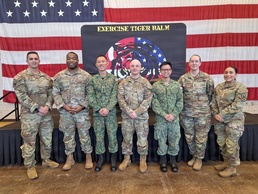
JOINT BASE LEWIS-McCHORD, Wash. — Contracting professionals from the Mission and Installation Contracting Command’s 418th Contracting Support Brigade demonstrated the value of early engagement and on-site analysis during final preparations for Tiger Balm 2026, ensuring requirements are clearly defined and fully supportable ahead of execution.
The final contract site survey, held Feb. 5–6 at Yakima Training Center, and the Final Planning Conference, conducted Feb. 9–12 at Joint Base Lewis-McChord, confirmed that contract requirements for the U.S. Army Pacific-sponsored Theater Security Cooperation Program capstone event are codified.
Tiger Balm 2026, scheduled for May 2–18, is a brigade-level live, virtual and constructive exercise with the Singapore Armed Forces designed to strengthen interoperability and readiness between partner forces. Exercise Tiger Balm is the longest-running bilateral training exercise between the U.S. Army and the Singapore Armed Forces.
During the survey, Maj. Michael Nelson and Sgt. 1st Class Antwoine Middleton, the brigade’s mobile contracting team, worked closely with planners from the Washington Army National Guard, [2nd Stryker Brigade Combat Team](), and the 593rd Expeditionary Sustainment Command to conduct site walks and mission analysis across key logistics nodes at both installations. The team inspected barracks, dining facilities and training locations to identify potential capability gaps requiring contract support — a core function of MICC professionals who translate operational needs into executable acquisition strategies. Nelson and Middleton were recognized by planners for exceptional coordination throughout the process, helping synchronize efforts across multiple commands and ensure the team remains fully postured to meet anticipated requirements.
“Getting eyes on the ground early is how we deliver precision contracting support to the warfighter,” said Col. Kizzy Danser, commander and senior contracting official for the 418th CSB. “Our contracting professionals do not wait for requirements to arrive on paper — they partner with supported units, conduct detailed site surveys and ensure we fully understand the mission before initiating contracting solutions.”
The site survey produced immediate benefits. During key leader engagements, the mobile team identified an existing Passenger Movement Branch capability at JBLM that enables units to request contracted bus transportation between JBLM and Yakima Training Center — a resource previously unknown to planners.
Nelson, a 418th support operations officer and member of the mobile contracting team who participated in the site survey, said the hands-on approach reduces risk and improves contract quality and speed once requirements are validated and finalized.
“Walking the terrain with our supported units allows us to reduce redundancy, spot gaps early and recommend solutions they may not have considered,” Nelson said. “That shared understanding up front is what makes contracting support both responsive and reliable when the exercise begins.”
In addition to the reconnaissance, the team strengthened internal coordination by conducting an office call with MICC-JBLM teammates to ensure alignment on the use of an existing chemical latrine indefinite-delivery, indefinite-quantity contract vehicle that will support the exercise.
Through insights gained during the site survey and planning conference, the team identified several minimum contracting requirements, including latrines and hand-washing stations at both locations, two climate-controlled 150-person dining tents for joint U.S. and Singapore forces, and linen services for barracks supporting approximately 400 personnel.
Looking ahead, the requiring activity, or supported unit, is expected to complete its requirements packet by March 1. The mobile team plans to solicit venue tents and linen services by early March and with contract awards no later than the end of April.
Danser said the Tiger Balm planning effort highlights the vital but often unseen work contracting professionals perform to enable training and readiness across the Army.
“This is what exceptional contracting operations look like,” Danser said. “Through deliberate planning, strong partnerships and disciplined site surveys, our brigade’s contracting professionals ensure our supported commanders have the supplies and services they need — when and where they need it most.”
The MICC contracting team reports it is fully postured to support Tiger Balm 2026 when needed, facilitating the continued strengthening of U.S. and Singapore military cooperation.
About the MICC Headquartered atJoint Base San Antonio-Fort Sam Houston, Texas, the Mission and Installation Contracting Command consists of about 1,500 military and civilian members who are responsible for contracting goods and services in support of Soldiers as well as readying trained contracting units for the operating force and contingency environment when called upon. A subordinate command of the Army Contracting Command and the Army Materiel Command, MICC contracts are vital in feeding more than 200,000 Soldiers every day, providing many daily base operations support services at installations, facilitate training in the preparation of more than 100,000 conventional force members annually, training more than 500,000 students each year, and maintaining more than 14.4 million acres of land and 170,000 structures.