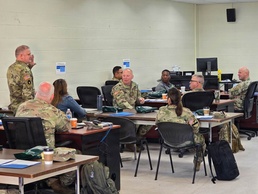
SAN ANTONIO, Texas — They gathered with a shared purpose. Prevent the kinds of mishaps that can change a family forever.
The work discussed in rooms like this reaches far beyond inspection checklists and training schedules. It is about protecting the mothers, fathers, sons and daughters who put on the uniform each day and making sure they return home safely to their families.
Around a table filled with notebooks, laptops and coffee cups, Army National Guard safety professionals from across the country compared stories most people never hear.
Close calls on training ranges. Mishaps that changed procedures. Small safety fixes that prevented bigger problems.
From Feb. 24-26, 2026, safety leaders met at Martindale Army Airfield Armory for the Army National Guard Safety Professional Mentorship Course hosted by the Texas Army National Guard.
The course, previously known as the “First 100 Days of Safety,” helps both new and experienced safety professionals strengthen programs that protect Soldiers across the Guard. Participants share real lessons learned, discuss challenges inside their states and build connections that help solve problems faster when issues arise.
Representatives attended from Alabama, California, Florida, Georgia, Hawaii, Idaho, Iowa, Kansas, Nevada, New Mexico, Oklahoma, South Dakota, Texas, Washington, Wyoming and Washington, D.C., along with the National Guard Bureau.
For three days the conversations moved quickly. Risk management. Inspections. Mishap investigations. Leadership responsibilities.
But the focus stayed simple. Keep Soldiers safe while maintaining readiness.
In the Wyoming Military Department, that balance reflects the organization’s vision of serving as both the Sword and Shield for the state and nation, said Maj. Craig Heilig, safety and occupational health manager for the Wyoming Army National Guard. Safety programs help ensure the Guard remains lethal and ready to fight when needed while also protecting the force that communities rely on during emergencies.
“This course is built around mentorship and relationships,” said Calvin Grade Jr., Oklahoma Army National Guard state safety and occupational health manager and course facilitator. “Safety information is always changing. Lessons learned from one state can prevent an incident in another. When we share those lessons and build relationships, we strengthen the entire Army National Guard.”
Some of the most valuable learning happened outside the classroom.
Participants walked through an Army Aviation Support Facility and conducted a hands-on safety inspection. Inside the hangar they examined maintenance areas and equipment placement while discussing how different states approach inspections.
The walk-through allowed newer safety professionals to see how experienced mentors identify hazards and ask questions others might overlook.
For Wyoming participants, the conversations carried real weight.
Guard operations in Wyoming often happen in challenging conditions. High winds. Long distances between training areas. Rapidly changing weather.
Safety professionals work behind the scenes helping commanders identify risks before they become injuries or accidents.
“This type of mentorship allows us to compare best practices and refine how we manage safety programs back home,” Heilig said. “Sharing experiences with other states strengthens how we prepare our Soldiers.”
Their work rarely makes headlines, but it touches every mission.
From aviation maintenance and vehicle operations to training exercises and range safety, safety professionals help ensure Soldiers remain ready to fight and ready to serve Wyoming communities during disasters and emergencies.
When the course ended, participants left San Antonio with new tools, new contacts and a stronger network they can rely on when challenges arise
“Because the next lesson learned should never come from an accident,” Heilig said.
-30-