At first glance, the mission of a Conservation Law Enforcement Officer (CLEO) might seem worlds away from the Army's core priority of building a more lethal and ready force. The image of an officer patrolling forests and waterways to protect wildlife appears distinct from the thunder of artillery and the rigorous training of soldiers. However, at Aberdeen Proving Ground (APG), these two worlds are not just connected; they are intrinsically dependent on one another. The work of officers like Lt. Matthew McDonough of the APG Directorate of Emergency Services is a critical, often unseen, component of national defense, ensuring that the warfighter has the environment and security necessary to train, test, and win.
This is not the work of a typical game warden. CLEOs at APG have a unique and complex mission that blends federal and state law enforcement with the stringent demands of installation security. "We enforce federal, state, and installation-specific hunting and fishing laws," said Lt. McDonough. This responsibility extends across a vast and varied landscape, from the forests and fields to the waters of the Chesapeake Bay and its tributaries. Their duties include protecting wildlife habitats, monitoring endangered species, and even safeguarding historical and archaeological sites scattered across the proving ground.
However, every one of these tasks is performed under the shadow of a much larger priority. "The primary job of a military base is to prepare for war," Lt. McDonough said. This means that military readiness is the paramount concern. Conservation activities, public recreation, and environmental management must all be balanced against the non-negotiable needs of military training and testing. This creates a dynamic and challenging environment where a CLEO's primary role is to ensure that nature and the military mission can coexist in a way that ultimately enhances the warfighter's effectiveness.
The First Line of Defense: Force Protection in the Field
One of the most direct ways APG's CLEOs contribute to lethality is by serving as a vital component of the installation's force protection and security apparatus. Their patrols in the most remote and austere corners of the proving ground are a first line of defense against a wide range of threats.
"By checking for hunting, fishing, or recreation permits, officers ensure that every individual in a training area is authorized to be there," said Lt. McDonough. This simple act is a powerful security tool, preventing unauthorized and unvetted individuals from gaining access to the installation under the guise of recreation. In an era of evolving threats, knowing who is on the installation is paramount.
These officers are constantly on the move, patrolling areas that are often inaccessible to traditional patrol cars. This constant presence deters criminal activity that extends far beyond poaching. "This is the first line of defense against individuals who may be engaged in criminal activity (like theft of military property), conducting surveillance, or who are simply lost and have wandered into a hazardous area," Lt. McDonough said. By intercepting trespassers, CLEOs prevent them from stumbling into areas with unexploded ordnance or, critically, into the path of a live-fire training exercise. This direct intervention hardens the installation's security posture and ensures the safety of both the military community and the public.
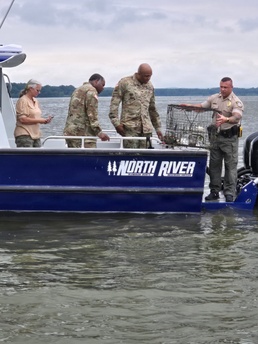
A concrete example of this mission assurance occurs frequently on the water. APG's restricted waterways are actively used for critical testing. "We have had multiple crabbers or fisherman illegally enter the closed waterway...when it’s closed for testing and completely disregard the Aberdeen Test Center (ATC) patrol boats," Lt. McDonough said. "We as CLEOs conduct vessel stops on these incursions and issue citations...This also prevents the tests from being disrupted and ATC can continue business and stay mission ready." Each stop is a direct action that keeps the Army's readiness mission on track.
Preserving the Battlefield: The Strategic Value of Stewardship
The link between environmental stewardship and warfighter lethality becomes even clearer when viewed from a strategic, long-term perspective. A lethal soldier is one who has trained in a realistic, challenging, and unpredictable environment that mirrors the friction of actual combat. Ensuring the sustainability of APG's natural training environments is therefore crucial for creating effective training scenarios.
"Sound stewardship directly prevents the degradation of military lands, guaranteeing that the rugged and diverse terrain needed to simulate military training conditions remains available and intact for generations of warfighters," Lt. McDonough said. Healthy forests, intact wetlands, and stable shorelines provide a dynamic landscape where soldiers can practice concealment, navigation, and adapting to natural obstacles—skills that are perishable and essential. A barren, featureless plain offers a sterile training experience that fails to replicate the uncertainty of a real-world battlefield.
More critically, proactive conservation is a mission-assurance strategy. Lt. McDonough points out that the greatest conservation-related risk to training is the potential listing of a new threatened or endangered species. Such a listing could trigger severe, legally mandated restrictions on land use, "directly limiting where, when, and how our soldiers can train."
To counter this, the CLEO strategy is "conservation for mission assurance." This involves aggressively monitoring at-risk species and implementing habitat improvement projects to bolster their populationsbeforethey become critical. "By making their habitats more resilient and their numbers more robust," Lt. McDonough said, "we demonstrate to our regulatory partners that we can manage these species effectively without the need for a formal listing." This proactive stance prevents future training restrictions, ensuring that APG's lands remain open and accessible for the warfighter.
Ultimately, the enforcement of these laws reinforces the very foundation of a lethal fighting force: discipline. As Lt. McDonough sees it, a service member's compliance with hunting or fishing regulations is a direct reflection of their personal integrity and respect for authority. When CLEOs interact with soldiers, they frame it as an act of stewardship over their own training grounds, reminding them that protecting the environment ensures the land remains a high-quality asset for the critical training that keeps them lethal and effective. In the complex ecosystem of military readiness, the guardians of the land and water are also the guardians of the mission.