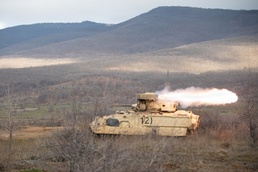
NOVO SELO TRAINING AREA, Bulgaria – As the final missiles are launched on the training range, U.S. Army Soldiers from the 1st Battalion, 16th Infantry Regiment, 1st Army Brigade Combat Team, 1st Infantry Division conclude their rigorous training cycle, marking the end of a nine-month European deployment aimed at strengthening NATO partnerships and enhancing combat readiness.
1-16th Infantry deployed from Fort Riley, Kansas last summer and are now regionally-aligned and allocated to V Corps. V Corps is the U.S. Army's only forward-deployed corps, tasked to operationalize the Eastern Flank Deterrence Line, train alongside NATO allies, provide combat-ready forces and, if necessary, defend the alliance's Eastern Flank.
Throughout the course of the rotation, 1-16th Infantry demonstrated various combat readiness exercises, from team-level training to a culminating combined arms live fire exercise (CALFX) while focusing on developing individual crews, target engagement and maneuverability.
Lt. Col. Thomas Sacchieri, the battalion commander for 1st Battalion, 16th Infantry Regiment, 1st Infantry Division highlighted the significance of training in Bulgaria.
“Since our arrival here, from day one, we've conducted the most realistic, combat focused training we can possibly do,” stated Sacchieri. “During our time here in Europe, we've taken advantage of a more permissive training environment. We've conducted live fire training from every echelon, from team to company level.”
Sgt. 1st Class Tyler Beard, a master gunner for the 1st Battalion, 16th Infantry Regiment, 1st Infantry Division emphasized the various elements of training conducted during the training cycle.
“1-16th Infantry has conducted individual weapons qualifications, team and squad live fire, Bradley and tank gunnery, mortar qualifications, section live fires, platoon live fires, and a combined arms live fire exercise,” said Beard.
Soldiers also conducted demolition training and explosive breaching while establishing more proficient maneuvering and fire suppression. Additionally, Soldiers received training while managing scenarios that included chemical, biological, radiological and nuclear (CBRN) situations.
“We’ve trained for 131 training days,” explained Sacchieri. “That's more than twice the number of days available to us at home station. We've also expended over 700,000 rounds of class V.”
Not only did the 1-16th Infantry build combat credible forces while training in Bulgaria, but they also had the opportunity to coordinate with their Romanian counterparts during a live fire training exercise, strengthening their joint operational readiness.
“1-16th Infantry rapidly deployed a tank platoon to Smardan Training Area, Romania for a combined platoon live fire with the 284th Romanian Armored Battalion, which resulted in cohesion amongst our NATO allies, with our ability to communicate on a tactical communication network and to integrate direct fire coordination with each other,” stated Beard.
The various training exercises held during the rotation allowed the 1-16th Infantry to increase their overall mission readiness, while also fostering competent and capable leaders.
“With an increased tempo, leaders were able to stress their abilities and gain confidence with being able to rapidly deploy to the field, conduct training and come out with more experience,” stated Beard. “Some lessons learned from our rotation, that our leaders and Soldiers will take moving forward, is the ability to rapidly plan different types of training events, live fire exercises, and the ability to do it safely and to standard.”
Soldiers from 1-16th Infantry continued to show their dedication not only in training, but also in their commitment to service throughout the rotation.
“As we return to home station, we look forward to building upon the foundation and lessons learned here in Europe,” said Sacchieri. “Overall, this has been a great experience and leadership opportunity for our Soldiers. They're thriving here. They've set goals and accomplished them. During the last six months on this deployment, we've had over 96 Soldiers reenlist or extend their contract.”
As Soldiers from the 1-16th Infantry conclude their rotation, they will apply the lessons and skills they’ve acquired to their upcoming training back at their home station.
“We will return to Fort Riley at a higher readiness level than when we arrived,” said Sacchieri. “We’ll return more lethal, more experienced and more ready for large scale ground combat operations.”
The nine-month intensive training cycle in Europe conducted by the 1-16th Infantry enhanced their ability as a cohesive combat fighting force and strengthened joint operational readiness with NATO Allies. 1st Battalion, 36th Infantry Regiment, 1st Armored Brigade Combat Team, 1st Armored Division will replace 1-16th Infantry in Bulgaria and continue fostering warfighting readiness along NATO's Eastern Flank.