When Alaska Army National Guard Land Component Commander Col. Aaron Kelsey greeted Director of the Army National Guard Lt. Gen. Jon Stubbs at the entrance of the Alaska Army National Guard Readiness Center on JBER Feb. 20, the mercury had plummeted to 6 degrees below zero with the chill condensing the air to the point the bronzed Minute Man statue standing watch over the Army officers’ meetup was festooned in a layer of frigid frost.
Standing as representation of the 1,542 citizen Soldiers and Arctic capable, mission-ready forces within the Alaska Army National Guard, the statue’s symbolism as a guardian sentry over the North emerged throughout the director’s visit.
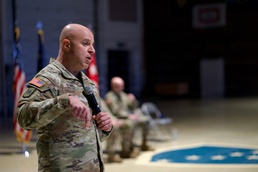
Stubbs, accompanied by Army National Guard Command Sgt. Maj. Brian Kendrick, met with Kelsey, AKARNG Command Chief Warrant Officer 5 Mark Nieto, and AKARNG Command Sgt. Maj. Jason Baker before meeting with AKARNG leadership and speaking to hundreds of AKARNG soldiers at the readiness center.
Kelsey and the AKARNG staff shared several issues with Stubbs and his staff during the leadership meeting.
Arctic aviation is right-sized
When Alaska overlays a map of the Continental United States, the vastness of the state is abundantly clear. The distance between Attu in the Aleutian Islands and Belle Bay in Southeast Alaska is 2,400 miles, nearly matching the 2,460 miles bridging New York City and Los Angeles.
Despite great distances, only a tiny fraction of the state is reachable by highway, requiring aviation to reach most communities. This paradigm came sharply into focus during fall 2025 hurricane-force storms that devastated Western Alaska communities. During the 207th Aviation Troop Command’s response, the helicopter unit flew more than 330 hours evacuating 501 civilians, transporting 741 disaster response personnel, and moving more than 90 tons of cargo.
Arctic Combat Casualty Care
The U.S. military has relied on the “Golden Hour,” a time standard of evacuating critically wounded and injured troops to a higher level of medical care, for the past two decades. Maj. Titus Rund, 207th ATC flight surgeon, said a more realistic standard in a highly contested Arctic environment is “Golden Days,” requiring extended and effective prolonged casualty care.
“We need to accept that medical evacuation may be delayed or denied altogether in a high-end Arctic fight,” Rund said. “Momentum wins war – and casualties stop momentum. If we can’t stabilize and protect our injured in the cold, we lose more than lives. We lose initiative.”
To address the considerable challenges for providing prolonged casualty care in Arctic or extreme cold environments, Rund submitted a patent on behalf of the Department of War for a casualty evacuation ecosystem.
The CASEVAC Ecosystem creates a “bubble of warmth” for the casualty and combat casualty care providers by allowing for docking of the casualty protection unit – a combined shelter and sled – with a purpose-built casualty collection point shelter. The design enables rapid evacuation from the point of injury to definitive roles of care.
Rund also conceived of and leads a team in the development of an Augmented Reality TeleMentor system funded by U.S. Northern Command through Special Operations Command North in support of Special Operations Forces Arctic Medic exercises. The goal of the system is to upskill medics to perform tasks under the TeleMentor direction of surgeon’s who can be hundreds of feet to hundreds of miles away from the “point of need” as demonstrated in the Ukraine conflict.
Drill travel reimbursement
Another challenge posed by the lack of roads in Alaska is getting Alaska Citizen Soldiers from their homes in rural Alaska to unit locations in Anchorage, Juneau, Fairbanks, or hub communities that host armories.
The Joint Travel Regulation permits the Secretary of War to authorize travel reimbursement for Reserve Component members commuting beyond local distances for monthly drills. However, policies in place limit the identification of critical shortages, which precludes drill travel reimbursement for most AKARNG Soldiers.
Missile Defense and the importance of Space
The DARNG boarded an AKARNG C-12 Huron executive transport aircraft Feb. 21 at JBER before making the short journey over the towering Alaska Range to Fort Wainwright where Stubbs observed infantry training before making the drive to the Fort Greely Missile Defense Complex where he met with 49th Missile Defense Battalion Soldiers.
After seeing the mission and training support missions at the Fire Team Readiness Facility, Stubbs spoke with Military Police Soldiers at the Security Control Center who are responsible for patrolling the complex on even the coldest and snowiest of days. Stubbs then moved to the Fire Direction Center where 49th MDB Soldiers spoke with him about how they detect, target, and destroy incoming ballistic missiles that threaten America.
‘Nobody can do what we do’
The general opened remarks for the AKARNG all-call by recognizing Alaska’s Soldiers’ response during the former Typhoon Halong in Western Alaska.
“What you were doing, no kidding, saved lives,” Stubbs said. “You were in the midst of hoisting people off structures that were swept out to sea, saving lives and preserving families. It was incredible.”
The general highlighted how National Guard Soldiers must be ready to respond to disasters and unrest inside their states while simultaneously standing ready to deploy overseas into a combat zone for federal contingency and wartime operations.
“Nobody does what the National Guard does,” Stubbs said. “Nobody can do what we do – Citizen Soldiers out there at the tip of the spear inside your respective states.
“Being a Soldier in the Army National Guard is a big deal,” Stubbs continued. “We’re 332,000 strong, across all 54 states, territories and the District of Columbia. Thirty-three percent of the Army is in the Army Guard. But here’s the deal: we’re the Combat Reserve of the Army, so that 42 percent of the [combat] power is in the Army National Guard.”
The DARNG commended AKARNG Soldier for being the Army National Guard’s and the nation’s Arctic experts.
“The things that you deal with in terms of the conditions, the tyranny of distance, and the challenges that come with operating in this type of environment, whether it is just training, Warrior Battle Tasks and Drills, collective training at echelon, it’s not simple,” Stubbs said. “It speaks to the character of this great organization.”
Stubbs said he and Kendrick are confident the AKARNG and the organization’s Soldiers are always ready to accomplish any mission, state or federal.
“We are proud of you, we are proud of who you are, what you do, and what you represent,” Stubbs said. “I leave you with this: We’re Guardsmen. We need to be proud of that. Nobody else can do what we do, nobody.”