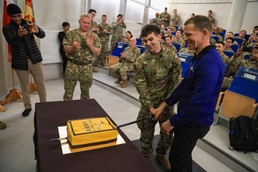
POZNAN, Poland, March 2, 2026 — Army Emergency Relief CEO, retired Sgt. Maj. of the Army Tony Grinston, traveled to U.S. Army Garrison Poland to launch this year's fundraising campaign — and to announce a new pilot program that extends financial assistance to Reserve Component Soldiers for the first time in the organization's 83-year history.
Since 1942, the Army Emergency Relief's mission has been supporting the well-being of Soldiers and Army families by helping alleviate financial stress and promoting economic stability. This year's financial support includes a record $13.5 million in grants — the highest number of grants in Army Emergency Relief history — $6.6 million in scholarships and $49.4 million in zero-interest loans.
As financial readiness is a key component of Soldiers' personal readiness, Army Emergency Relief focuses on providing services and programs that take care of the Army's most valuable asset, the Soldiers. This year's campaign motto is "Empowering Soldiers, Enhancing Lives."
This year marks the beginning of a new pilot program to provide support to Reserve Component Soldiers. The initiative provides limited financial grants for food, utilities and various forms of vehicle and travel assistance.
The pilot program extends eligibility to support U.S. Army Reserve (USAR) Soldiers not on active duty, specifically Troop Program Unit, TPU, and Individual Mobilized Augmentee, IMA, Soldiers. The pilot applies to those TPU and IMA Soldiers performing Inactive Duty Training, IDT, , to include serving on orders less than 30 days, and provides limited assistance for food, utilities and vehicle expenses in the form of a grant.
"This pilot program will be great for our reserve component Soldiers,” said U.S. Army Reserve Col. Daniel Meyers, commander of the 510th Regional Support Group, 7th Mission Support Command. "With progress, we can ensure more opportunities are to come in the near future to better support our Soldiers."
<br> This pilot program aims to close the access gap for Reserve Component Soldiers, as those service members often fell into a gray area of eligibility. By expanding eligibility, the Army reinforces that readiness includes financial stability.
"It is called Army Emergency Relief, not active army relief," said Grinston. "We want to help Soldiers in all components as we are all one team to impact financial readiness in a major way."
For many Reserve Soldiers balancing civilian careers and federal service, unexpected expenses can quickly compound. The pilot program ensures that when they answer the nation's call, systems are already in place.
If successful, the pilot program could become permanent policy and strengthen trust between the Reserve Component and the Active Army.
-30-